

My Testimony to UK Parliament
Here is my full statement with citations and a video of my speech

Statement by Emily Cherkin, M.Ed. for The Right Honourable Laura Trott MP
UK Parliament, November 24, 2025
To view the video of my testimony, please visit this link.
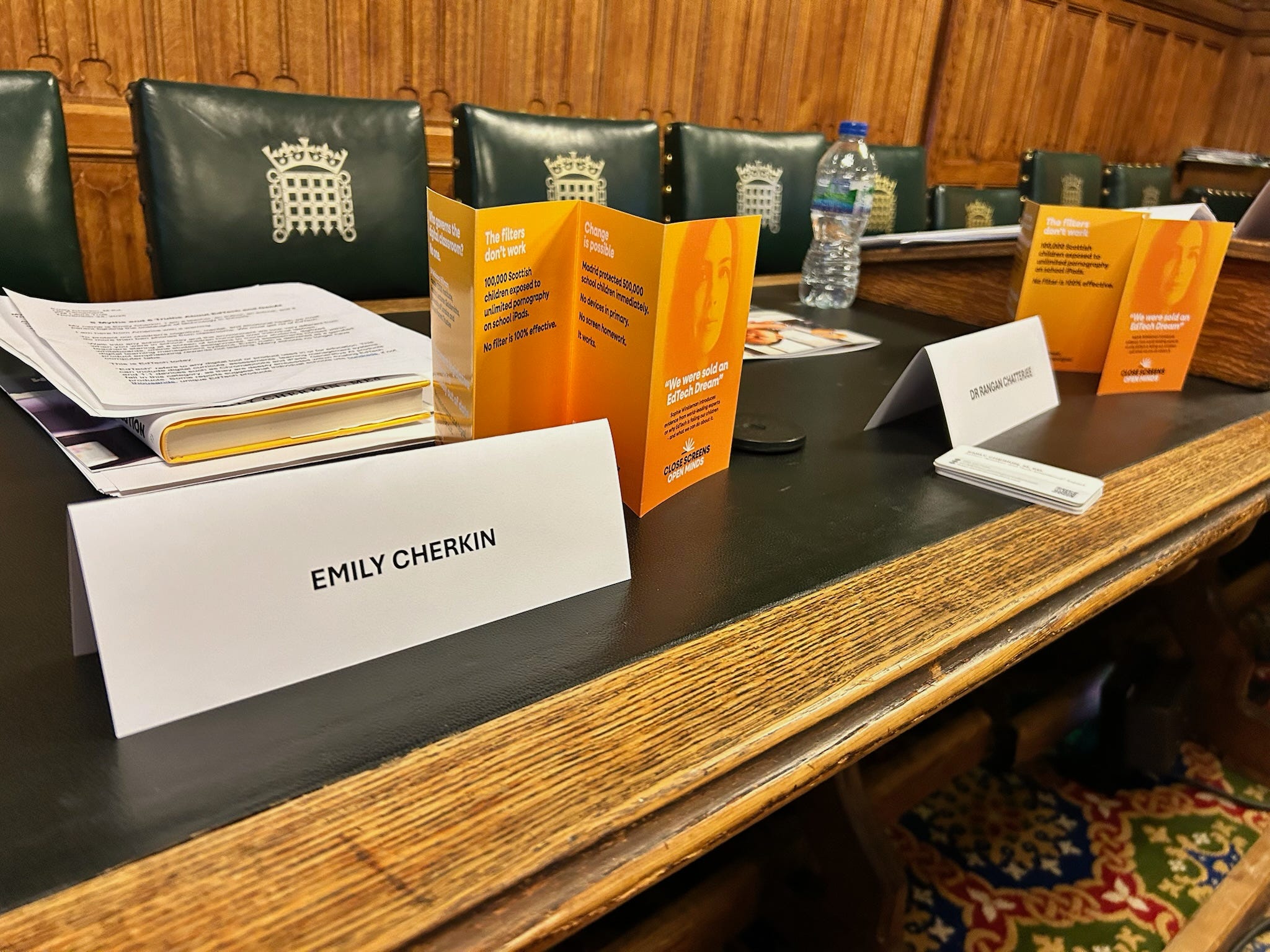
6 Myths and 6 Truths About EdTech and GenAI
My name is Emily Cherkin. I am a teacher, an author, an activist, and a parent fighting the onslaught of technology in schools.
I am here from America with a warning.
To protect our children’s cognitive, mental, and emotional health we must do more than ban phones from classrooms. We must get rid of EdTech.
Walk into any school today and the environment will look very different from when you were in school: children hunched over individual laptops, teachers staring at a screen of screens to monitor students, digitized whiteboards, online student assignments, and assessments housed within digital learning management systems. Even math is delivered as a gamified product emphasizing rewards not learning. Many schools no longer have computer labs.

This is EdTech today.
“EdTech” refers to any digital tool or product used in or for education. This can include digital curricula, assessments, learning management systems, and 1:1 devices such as Chromebooks and iPads. Generative AI products fall in this category, as they are deeply embedded within existing EdTech products. Some reports suggest that individual schools use hundreds[1] if not thousands[2] unique EdTech products.
If you remember nothing else I say today, please let it be this: at its very core, the business model of EdTech is no different from the business model of Big Tech and both are fundamentally at odds with healthy child development. Big Tech has already co-opted the social lives of our children; we cannot let them co-opt their education too.
After all, EdTech is just Big Tech in a school uniform.
The incursion of EdTech products into schools is powered by several myths. We have been hoodwinked into believing that these products are effective, safe, and legal. They are not.
To fight back, we must first dismantle these myths, and then seek what I call a “tech-intentional” vision for education, where technology serves the needs of children and teachers, rather than tech companies.
Myth: “EdTech improves learning.”
Truth #1: EdTech worsens learning outcomes.
There is plenty of evidence[3] that the onslaught of computer-based learning has not delivered on its claims and has a detrimental effect on student achievement. The OECD[4], the National Library of Medicine[5], and over 126 independent studies[6] have found that increasing access to technology for students does not improve learning outcomes. One study[7] based on over 300,000 primary students, found that even 30 minutes of digital device use in class had a negative impact on reading comprehension scores. Another found that investing in air conditioning yields a 30% improvement in learning outcomes[8] over giving children a Chromebook. Finally, overwhelming evidence exists to show that reading[9] and writing[10] on screens harms[11] cognition.[12]
EdTech claims to help students learn faster and better. But learning occurs in moments of struggle and difficulty. When we attempt to make learning “more efficient” we by definition stop the learning process. Friction is a good thing in education and learning requires time.
Myth #2: “EdTech helps teachers.”
Truth #2: EdTech is ruining teaching.
At its heart, EdTech seeks to fundamentally change the nature of teaching. The end goal of EdTech companies is to “scale” instruction, so that one teacher can serve even more kids. Yet to think of children or teachers as scalable widgets is morally abhorrent and deeply offensive. “Success,” according to the EdTech industry, would mean fewer teachers serving more students and increasing teacher workload and class sizes, while turning teachers into IT administrators instead of mentors and instructors. It’s no wonder teachers are quitting or retiring early.
Learning is rooted in human relationships, a goal which EdTech is fundamentally at odds with. EdTech tools don’t help teachers; they help schools hire fewer teachers, while generating profits for EdTech companies.
Myth #3: “EdTech can close the achievement gap.”
Truth #3: EdTech worsens inequities.
EdTech companies would have you believe that access to their devices and services helps disadvantaged children close the achievement gap. But far from improving equity, EdTech creates new “digital divides”: a digital safety divide and a digital learning divide.
First, safer versions of EdTech cost more. Monetizing safety and privacy means under-resourced schools receive less safe versions of the product. That is inequitable.
Second, EdTech is offered as a “solution” to ballooning class sizes. But as my colleague Dr. Velislava Hillman has warned[13], EdTech solutions in under-resourced schools means privileged children will get human teachers, while poor children will get technology and chatbots.
We only need to look where technology executives themselves send their children[14]– to nature-based[15], low-tech schools[16]– to see the truth: those who build and market these products for our children make starkly different choices for their own families.
Myth #4: “EdTech is safe for children.”
Truth #4: EdTech products harm children.
EdTech companies claim their products are safe for use by children, but these very products rely on the internet to deliver their services and the internet is not a safe place for children. Children are also not small adults. Developmentally-speaking, they lack the cognitive ability to safely navigate the web or regulate their own screen use. Yet via school-issued devices, children are accessing pornography,[17] pedophiles,[18] suicide[19] videos, and extremist[20] content.
We face an international mental health crisis[21] and loneliness epidemic[22] among young people. Removing phones from schools– the absolute right thing to do– without removing internet-connected devices from student’s backpacks simply transfers the risks of harm from an iPhone to a Chromebook.
Another pernicious harm is in the exposure of children’s data collected via EdTech platforms and sold to third parties without informed parental consent. My colleagues Andy and Julie Liddell will address this next.
Finally, we cannot ignore the fact that the embedding of GenAI tools into existing EdTech platforms further exposes children to newer and bigger risks.[23] A.I. tutors are A.I. chatbots and the emerging evidence of harm[24] due to use of chatbots by children is serious, significant, and deeply concerning.[25] Just as there is no such thing as a safe cigarette, there is no such thing as safe GenAI for children.[26]
Myth #5: “EdTech prepares kids for a technological future.”
Truth #5: Children need TechEd, not EdTech.
The most common argument for EdTech is that it will prepare our kids for “jobs of the future.” In reality, technology may have changed, but children’s needs have not. While the jobs of the future will utilize technology, the skills that children need to use such technologies effectively will come from acquiring communication, collaboration, critical thinking, and problem-solving skills in childhood. We cannot know what technologies will matter in ten years, but we do know that solving problems and thinking critically will always matter.
Let me be clear: Children need technology skills. They need to learn how technology works and how to use it safely. But do not confuse “EdTech” with “TechEd.”[27] Children should learn about technology: what is “the internet”; how it works; what is an “algorithm”; what is an LLM and how it is built; how to discern fact from fiction; why protecting your data is important; and so much more.
But none of that is EdTech.
As policymakers and leaders, it is critical that this body sees the existential risk posed by giving such products to children and calling it education. The degradation of skills due to overreliance on technology is a serious threat to democracy[28] globally and we must ask why such tools are being given to children with vulnerable brains in the name of education in the first place and do what we can to stop it.
A functioning democracy requires a thoughtful and capable citizenry. EdTech products fundamentally threaten that.
Myth #6: “We can’t fight EdTech. It’s too late.”
Truth #6: EdTech is not a foregone conclusion.
The most pernicious myth perpetrated by EdTech companies is that it is too late to remove their products from education.
Do not accept this.
We will have and use technology in the future. But if we get this right, children will not be harmed in the process. It is possible to build a safer internet, regulate technology companies, and protect children’s data and privacy as the default. Of course, if technology companies wanted to do any of this, they would have. But they choose not to because it’s out of alignment with their business model. The only way these companies will meaningfully change is if they are forced to put the needs of people before profits. We have done this before with tobacco, dangerous chemicals, automobiles, and even banks. We can do the same with EdTech.
I have heard many times that this fight feels like David versus Goliath. It is true– we aren’t as well-funded or platformed as the mighty technology behemoths we battle. On a personal note, I am fighting this in the States as the lead plaintiff in a class action lawsuit against one of the largest American EdTech companies.[29] At times, I feel very much like small David with my slingshot.
Disentangling ourselves from the enmeshment of EdTech will be messy and difficult and a long process. But that doesn’t mean we give up or walk away without trying.
We have a choice– none of this is a foregone conclusion.
And remember, in the story of David and Goliath, it is the end of the story that is the part of this analogy that matters:
David won.
Thank you.
To view the video of my testimony, please visit this link.
[1] Internet Safety Labs: K-12 Edtech Safety Benchmark Findings Report (2022) https://internetsafetylabs.org/wp-content/uploads/2023/06/2022-K12-Edtech-Safety-Benchmark-Findings-Report-2.pdf
[2] The EdTech Top 40: K-12 EdTech Engagement https://www.instructure.com/edtech-top40
[3] “The EdTech Revolution Has Failed: The case against student use of computers, tablets, and smartphones in the classroom” by Dr. Jared Cooney Horvath (After Babel Substack)
[4] OECD Report “Students, Computers and Learning: Making the Connection” (2015)
[5] Salmerón L, Vargas C, Delgado P, Baron N. Relation between digital tool practices in the language arts classroom and reading comprehension scores. Read Writ. 2023;36(1):175-194. doi: 10.1007/s11145-022-10295-1. Epub 2022 May 7. PMID: 35571994; PMCID: PMC9076497.
[6] J-PAL Report “Will Technology Transform Education for the Better?” (2019)
[7] Salmerón, L., Vargas, C., Delgado, P. et al. Relation between digital tool practices in the language arts classroom and reading comprehension scores. Read Writ 36, 175–194 (2023). https://doi.org/10.1007/s11145-022-10295-1
[8] Tracey Gunter, Jing Shao; Synthesizing the Effect of Building Condition Quality on Academic Performance. Education Finance and Policy 2016; 11 (1): 97–123. doi: https://doi.org/10.1162/EDFP_a_00181
[9] Liao, Sixin et al. “Dynamic reading in a digital age: new insights on cognition.” Trends in Cognitive Sciences, Volume 28, Issue 1, 43 - 55
[10] Marano G, Kotzalidis GD, Lisci FM, Anesini MB, Rossi S, Barbonetti S, Cangini A, Ronsisvalle A, Artuso L, Falsini C, Caso R, Mandracchia G, Brisi C, Traversi G, Mazza O, Pola R, Sani G, Mercuri EM, Gaetani E, Mazza M. The Neuroscience Behind Writing: Handwriting vs. Typing-Who Wins the Battle? Life (Basel). 2025 Feb 22;15(3):345. doi: 10.3390/life15030345. PMID: 40141690; PMCID: PMC11943480.
[11] U.S. Department of Education, Institute of Education Sciences, National Center for Education Statistics, National Assessment of Educational Progress (NAEP), various years, 1971–2023 Long-Term Trend (LTT) Reading and Mathematics Assessments.
[12] Nataliya Kosmyna, Eugene Hauptmann, Ye Tong Yuan, Jessica Situ, Xian-Hao Liao, Ashly Vivian Beresnitzky, Iris Braunstein, Pattie Maes. Your Brain on ChatGPT: Accumulation of Cognitive Debt when Using an AI Assistant for Essay Writing Task. June 2025.
[13] Dr. Velislava Hillman. “Big tech has transformed the classroom – and parents are right to be worried.” The Guardian. Sept. 2025.
[14] Chris Weller. “An MIT psychologist explains why so many tech moguls send their kids to anti-tech schools.” Business Insider. November 2017.
[15] https://www.nytimes.com/2011/10/23/technology/at-waldorf-school-in-silicon-valley-technology-can-wait.html
[16] https://wezift.com/parent-portal/blog/why-tech-ceos-raise-their-kids-tech-free/
[17] Alyson Klein. “Students Are Viewing Porn at School. How Educators Can Stop Them.” Education Week. January 2023.
[18] Z.G. v. Google LLC. The EdTech Law Center. Case filed June 2025.
[19] https://www.nytimes.com/2025/08/26/technology/chatgpt-openai-suicide.html
[20] Odette Youseff. “Nihilistic online networks groom minors to commit harm. Her son was one of them.” NPR. August 2025.
[21] Office of the Surgeon General (OSG). Protecting Youth Mental Health: The U.S. Surgeon General’s Advisory [Internet]. Washington (DC): US Department of Health and Human Services; 2021. PMID: 34982518.
[22] Report of the WHO Commission on Social Connection. “From loneliness to social connection:
charting a path to healthier societies.” (June 2025)
[23] National Education Policy Center Report. “Fit for Purpose? How Today’s Commercial Digital Platforms Subvert Key Goals of Public Education.” (September 2025)
[24] Sanford, John. “Why AI companions and young people can make for a dangerous mix. Psychiatry & Mental Health, Stanford University.” (August 2025).
[25] Horwitz, Jeff. Reuters. “Meta’s AI rules have let bots hold ‘sensual’ chats with kids, offer false medical info.” (August 2025).
[26] Cherkin, Emily. “There is No Such Thing as “Safe AI” for Children.” (August 2025).
[27] Cherkin, Emily. “EdTech is Not Tech Ed.” (November 2025).
[28] Cherkin, Emily. “Why Opting Out of EdTech Matters Now More Than Ever: A Fight for Democracy.” (November 2024).
[29] Cherkin, et al. v. Powerschool Holdings, Inc., 3:24-cv-2706 (N.D. Cal.) Filed on: 05.06.2024