

If EdTech Products are Expensive, Ineffective, and Extractive, Why Are We Still Using Them?
Thoughts from a school board director and an education advocate on why we might want to reconsider EdTech products before doubling down


Note from Emily: Abigail Rubin is a school board director in the Lower Merion School District in Pennsylvania. She is also an Occupational Therapist and a mom of four children. She recently invited me to coauthor an Op-Ed about screen-based technology in school. We couldn’t find a home for it elsewhere, so I offered to post it on First Fish Chronicles. There are so many new people are joining in the efforts to roll back EdTech and this piece provides a helpful overview and offers a recommendation for parents ready to challenge what’s become the status quo.
P.S. We also need more first fish to run for school board— you do not need to be an expert in education or an experienced politician; you just need to want to DO something to effect change, like Abigail did!
In 2013, Bill Gates optimistically said, “We won’t know for ten years” if investing in educational technology (EdTech) will improve learning. Now, in 2026, there is growing concern about the disconnect between how students learn and how they are being taught, and whether we are getting our return-on-investment from school-issued internet-connected, one-to-one devices.
EdTech in classrooms: our current reality
Nearly 90% of American public schools provide students with one-to-one devices, a shift that began around 2020. However, with national education assessment progress scores holding steady below the 2019 pre-pandemic levels, the hope that these devices could bridge the achievement gaps between racial and socioeconomic groups has not been realized. In fact, research from Dr. Jared Cooney Horvath suggests that EdTech appears to be widening the chasm. In Pennsylvania, over 60% of 8th graders have fallen behind in math or reading, and just 41% of 4th graders are proficient in math.
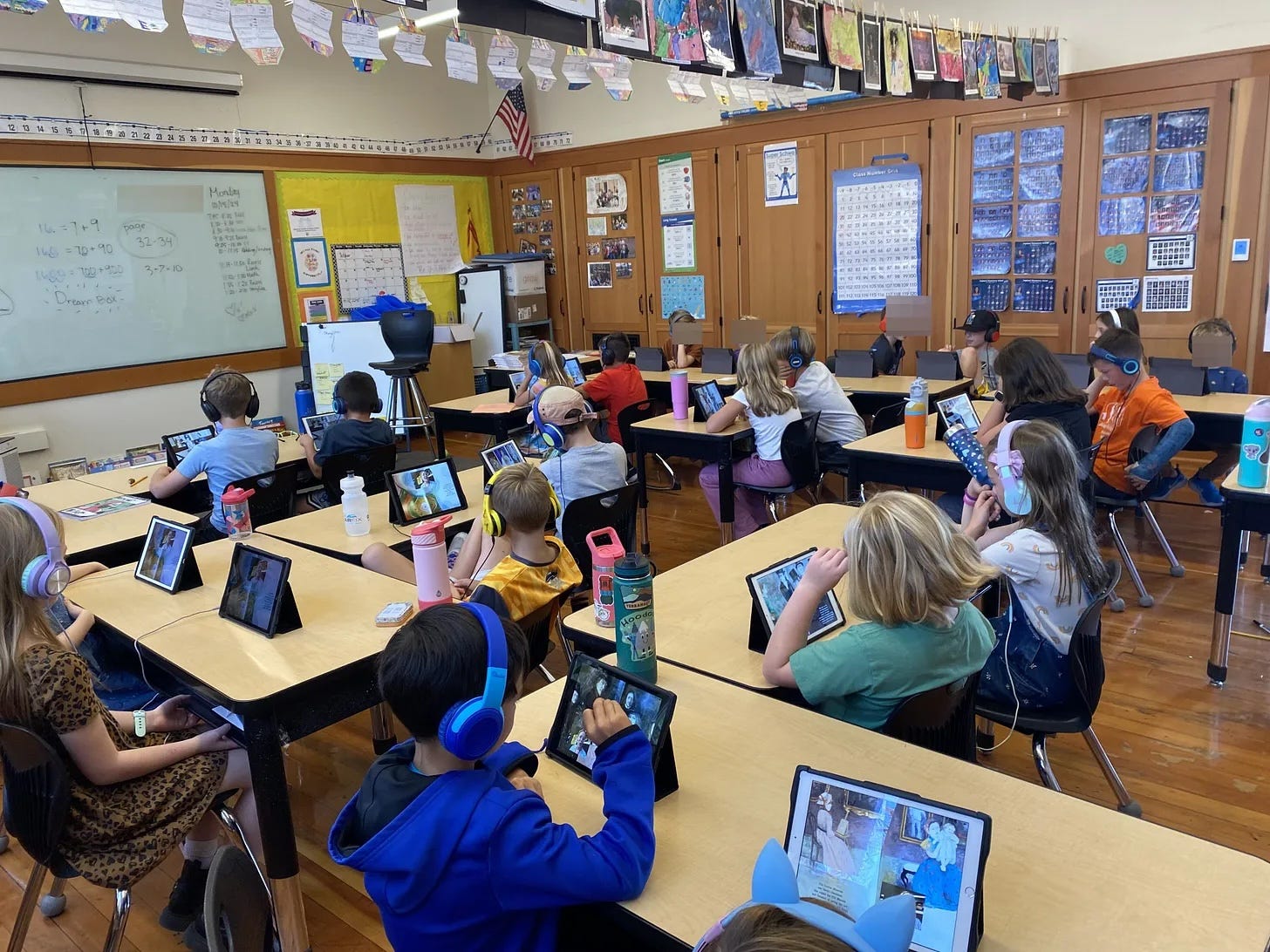
Schools send mixed signals by handing out one-to-one devices that are persuasively designed to glue children to their screens, and then expecting children not to be distracted. Furthermore, one-to-one devices risk eroding critical thinking skills. Case in point: according to Pew Research Center, 29% of teens used ChatGPT to answer math questions in 2025, a sharp increase in just two years. When children are given a homework machine, it should not be surprising when they use it.
The impact of one-to-one device use on children’s attentional skills has reached troubling levels. One study suggests that students using classroom devices are off-task as much as 38 minutes of every hour. Young children are somehow expected to toggle between browser tabs while focusing on and off screen. Meanwhile, teachers are often forced to police inappropriate screen-use. We cannot expect teachers to model healthy screen habits – let alone teach – in this environment.
Nobody denies that today’s students must learn about the internet, AI, algorithms, and basic computing skills. But, as teacher and activist Emily Cherkin says, “TechEd is not EdTech.” The most trusted sources for “digital citizenship curriculum”, such as Common Sense Media and International Society for Technology (ISTE), must be scrutinized for their dubious roles in shaping children’s values when they receive funding from Google, Chan-Zuckerberg Foundation, and more. The same scrutiny must be applied to partnerships between teacher’s unions and AI companies, such as the troubling new partnership between the American Federation of Teachers and OpenAI to open The National Academy for AI Instruction.

Privacy invasion is another, even more pernicious – and often hidden – problem with EdTech products. In 2025, the Federal Trade Commission clarified that under the Child Online Privacy Protection Act (COPPA), schools cannot consent on behalf of parents to data and privacy collection. Yet, the vast majority of EdTech products collect student data without explicit parental consent. Schools rarely provide clear, accessible information about the data collection and privacy practices of EdTech products. When privacy rights erode, students’ data can be exploited. Parents who do not consent must be permitted to opt their children out.
So, why don’t schools scale back?
One explanation is inertia. These devices served as an educational lifeline during the spring of 2020, but as Cherkin rightly says, “a life raft is not long-term housing.” After committing to one-to-one devices for virtual learning years ago, districts are now reluctant to unwind multi-year contracts, even as kids and teachers have returned to class. Notwithstanding their costly and short lifespans, schools continue to spend billions every year on screens, despite growing concerns about their impact.
Another explanation parents hear is that because standardized tests are now administered digitally, students need constant exposure to devices. But as Dr. Horvath argues, digital tests don’t require digital classrooms. If testing must be online - a big “if” - students only need a few intentional lessons about digital test-taking. Ideally, especially for young children, assessments would return to paper and pencil, which is far more developmentally appropriate and better for performance. Regardless, screen-based tests do not warrant the degree of current screen adoption.
So, what’s a parent to do?
Until EdTech is independently shown to be safe, effective, legal, and demonstrably superior to traditional instruction, parents must be given the right to opt out, and instead, opt back into a teacher-led model. We acknowledge that this shift would not be simple, but how many more children should experience harm before changes are made?

About the authors
Abby Rubin is an elected school board member in Lower Merion School District and an occupational therapist. She lives in Bala Cynwyd and is the mother of four children.
Emily Cherkin is a speaker, writer, and teacher. Her work can be found here and at The Screentime Consultant.
Works Cited
Cherkin, Emily. The EdTech Backlash. As more pa
rents and educators begin questioning the digitization of childhood and the rapid expansion of screens in schools, this conversation feels more urgent than ever. 2026. YouTube.com. Accessed 26 April 2026.
Cherkin, Emily. “The EdTech Enmeshment Problem—and How to Fix It.” Institute for Family Studies, 21 November 2025. Accessed 27 April 2026.
Cherkin, Emily. “Hey, School Leaders: How Many Students Should Be Able to Access Chatbots, Predators, and Porn Before You Will Make a Change?” First Fish Chronicles, Substack, 23 April 2026. Accessed 29 April 2026.
Cherkin, Emily and Denise Champney. “An Uncomfortable Union.” First Fish Chronicles, Substack, 27 February 2026. Accessed 27 April 2026.
Cherkin, Emily. “”EdTech” is *Not* “Tech Ed”.” First Fish Chronicles, 5 November 2025. Accessed 27 April 2026.
Commission, Federal Trade. “FTC Finalizes Changes to Children’s Privacy Rule Limiting Companies’ Ability to Monetize Kids’ Data.” Federal Trade Commission, 16 January 2025. Accessed 27 April 2026.
“Common Sense 2024-2025 Annual Report.” Common Sense 2024-2025 Annual Report, 2025. Accessed 27 April 2026.
Cooney Horvath, Jared. “Digital Tests Don’t Require Digital Classrooms.” The Digital Delusion, 14 April 2026. Accessed 27 April 2026.
Cooney Horvath, Jared. “The Equity Illusion of EdTech.” The Digital Delusion, Substack, 7 April 2026. Accessed 30 April 2026.
“Fast Facts: Long-term trends in reading and mathematics achievement (38).” National Center for Education Statistics (NCES). Accessed 27 April 2026.
Federer, Roger. “Bill Gates Harvard Commencement Address 2007.” YouTube, 20 May 2013. Accessed 29 April 2026.
Freed, Richard. “The Secret Silicon Valley Science Stealing Childhood.” Medium.com, Medium.com, 6 January 2025. Accessed 30 April 2026.
Freed, Richard. “The Trusted Health Organizations That Are Selling Out Our Kids.” Substack.com, Substack.com, 31 July 2025. Accessed 30 April 2026.
“Google.org Announces Grant to ISTE+ASCD to Launch GenerationAI, Providing AI Training for Educators.” ISTE, 18 September 2024. Accessed 27 April 2026.
Hahn, Gregory. “Screen Time Side Effects in Kids and Teens.” Johns Hopkins Medicine. Accessed 29 April 2026.
Labs, Internet Safety. “COPPA-Rulemaking-Comments-Internet-Safety-Labs.pdf.” Internet Safety Labs, 2024. Accessed 26 April 2026.
Langreo, Lauraine. “Chromebooks’ ‘Short’ Lifespan Costs Schools Billions of Dollars, Report Finds.” EdWeek.com, Ed Week, 26 April 2023. Accessed 28 April 2026.
Lurye, Sharon. “School AI surveillance like Gaggle can lead to false alarms, arrests.” AP News, 8 August 2025. Accessed 29 April 2026.
MacArthur, John. “A groundbreaking study shows kids learn better on paper, not screens. Now what?” The Guardian, The Guardian, 17 January 2024. Accessed 30 April 2026.
“More than Half of Public School Leaders Say Cell Phones Hurt Academic Performance | IES.” Institute of Education Sciences, 19 February 2025. Accessed 28 April 2026.
“NAEP State and District Snapshots.” National Center for Education Statistics (NCES), 10 October 2025. Accessed 27 April 2026.
NBC News. “Los Angeles becomes the first major school district to require screen time limits.” 21 April 2026. NBC News.
Prothero, Arianna, et al. “Schools Spend $30 Billion on Tech. How Can They Invest In It More Wisely?” Education Week, 10 October 2025. Accessed 28 April 2026.
Rogelberg, Sasha. “The U.S. spent $30 billion to ditch textbooks for laptops and tablets: The result is the first generation less cognitively capable than their parents.” Fortune, 21 February 2026. Accessed 30 April 2026.
Schwarz, Joel, and Emily Cherkin. “Student privacy laws remain the same, but children are now the product.” The Hill.com, The Hill.com, 3 August 2022. Accessed 30 April 2026.
Sidoti, Olivia, et al. “Share of teens using ChatGPT for schoolwork doubled from 2023 to 2024.” Pew Research Center, 15 January 2025. Accessed 27 April 2026.
“Unregulated use of laptops over time in large lecture classes.” Computers & Education, vol. 78, no. September, 2014, pp. 78-86. Science Direct. Accessed 28 April 2026.