

Our Republic, If We Can Keep It
The fight against EdTech is a fight for the Future of Democracy

Note from Emily: This essay was originally posted on November 11, just days after the 2024 presidential election. Two and a half years later, as our country approaches its 250th birthday celebration, I have been thinking more than ever about our democracy and what we must do to keep it. I have lightly edited it from the original.

One of the best things I’ve learned from being an advocate for tech-intentional parenting and schools is that by and large this is (or at least, has been) a mostly non-partisan issue. Politicians I would never agree with on almost any other measure agree with me that Big Tech has way too much influence in our children’ s lives, and it brings me hope when senators and representatives come together to push for change.
There is no question there is still a lot of work to do, and that some leaders are very much captured by Big Tech money. And if this past week’s U.S. presidential election showed us anything it is that “political technology” in the form of mis- and dis-information played a significant role in guiding millions of people to vote. Fear is a powerful motivator and when weaponized in the form of scare-tactic marketing and manipulative advertising, it drives people towards a distorted worldview. (Not to mention that we are inundated by so much more information than any previous generation through applications like social media that are unlikely to be free of bias and where many people now go first to consume “news.”)
And to be clear, I see this occurring on both the left and the right.
This shouldn’t surprise us, really, as we’ve known for over a decade now that social media, YouTube, and online news sites are largely funded by companies with vested interests in specific outcomes. We are all cogs in a bigger machine, vulnerable to the algorithms and caught up in the spin. For those of us raised in a pre-internet world, where our critical thinking skills were honed on difficult texts and handwritten essays, we are able to step back and view the current state of things with some perspective.
Like many before me, I put great stock in the younger generations to forge a better world than the one that marred by the errors of my own generation. But the youngest voters in 2024 represent the tip of a spear of a generation of children who were raised on iPads and TikTok, yes, but worse– who also experienced, just as their tender young minds were developing, an influx of digital technology into their classrooms, the displacement of their teachers as experts of their crafts, and the dumbing down of content in the name of equity.
As a result, today we see college students unable to persevere through long texts, an emerging workforce struggling with underdeveloped executive function and dehumanizing AI mandates, and an electorate unable to think critically about the choices before them, not just for lack of skills, but also for lack of context.
This concerns me deeply, as it threatens to undermine trust in institutions that are already fragile. “It’s a republic, if you can keep it,” warned Benjamin Franklin in 1787.
In response to this week’s election results, there has been much worry and panic, some of it warranted. But hand-wringing, virtue-signaling, and retreating back into a tent that is already too small will not save us, our children, or our institutions.
Because while propaganda-generated fear won this election, there is another reason so many electorates were duped. Yes, deeply held systemic issues rooted in misogyny and racism absolutely exist. And yes, many people’s real lives are much more affected by issues like feeding their families or paying for gas than feeling concerned about climate change (whether that appears rational or not– for many, it is a reality). And yes, fear blinds us, but that’s true for both sides of the political spectrum.
What concerns me, and what drives me to believe more than ever that resisting EdTech and GenAI is going to become more imperative in changing the course of history, is the reality that those who control the children, control the future. (And yes, that is a paraphrase of a quote attributed to Adolf Hitler, not someone I’m prone to citing.)
Today, schools face continued and increasing pressure to adopt digital technologies, including GenAI products, that are far from ready for primetime and far from appropriate for children. Yet schools are doubling down on EdTech, digital curriculum, and 1:1 programs for children as young as preschool in the name of the future, in the name of “21st century skills,” and in the name of equity.
This is wrong. EdTech is an industry, just like Big Tech, who is doing more damage than good and to think otherwise is a direct threat to democracy itself.
Broadly speaking, here are a just few ways EdTech harms children:
EdTech collects massive amounts of data about our children and their families without our informed consent, then sells this information to third parties for profit. The erosion of privacy rights is a slippery slope— the erosion of other civil rights soon follows. This is dangerous for all of us.
EdTech utilizes addictive, persuasive design elements (much like social media platforms do); targets advertisements to children; normalizes constant surveillance; creates “algorithmic profiles” that leads to predictions about our child’s future behaviors; displaces other essential learning activities; and undermines family values.
EdTech doesn’t work: student outcomes are not improving; 21st century skills are not tech-based; and education is being reshaped to serve EdTech companies, not children and teachers. EdTech products impact focus, learning, and development negatively.
And in addition to serious privacy and data violations and the nefarious business practices which profit from it, all of these harms also negatively impact higher-level thinking skills like critical thinking, empathy, and creativity, which are absolutely necessary to being an active member of a democracy.
The day after the 2024 election, I took my then 13-year-old daughter to the new exhibit at our local aquarium. There was a new exhibit we hadn’t seen, and I decided to go find some first fish to inspire me and put some things into perspective. Standing in front of a huge aquarium teeming with tropical fish, we watched the Nemos and Dorys swimming among brightly colored coral. The tank was beautiful, but all the exhibits in the new space were accompanied by touch screens, some at toddler-height, encouraging visitors to “explore” information about the fish in the tank. Despite the flashiness of the new building, I found myself preferring the simplicity of the older part of the aquarium, where a quick glance at printed signs told me the fish names and a few facts about them, and allowed me to spend more of my time watching the actual fish in the tank.
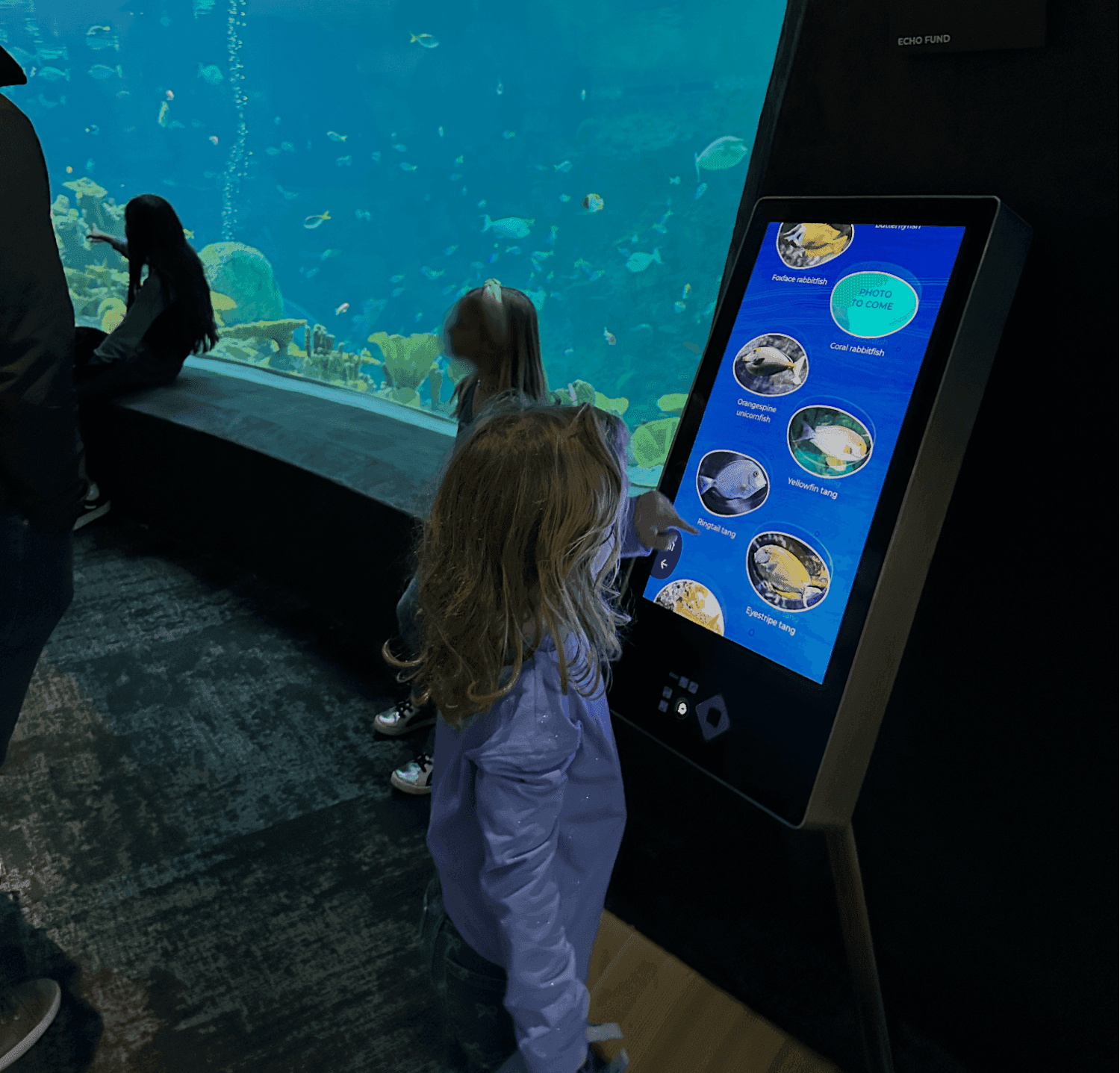
Next to us, a mother and her five-year-old son approached the tank. Instead of coming up to the glass to see the fish, however, the little boy beelined straight for the touchscreen display to the left. He started tapping furiously, unable to read any of the text, but very satisfied by the flashing digital display that responded to his every tap.
Clearly frustrated, his mother tugged at his arm and said, “Let’s stay off the screen and go look at real stuff.” Eventually, he complied. I had wanted to capture a video of a school of fish swimming to use in my presentations and managed to catch this parent’s plea in the background of my video. If you listen carefully, you can hear here at the end:
Children’s brains cannot compete with the pull of digital technology when it is an option, whether in front of a beautiful wall of real-life tropical fish or in a classroom. Teenagers will be swayed by manipulative algorithms in their social media feeds that tell them what it means to be beautiful or athletic or successful, and might perpetrate real-world harms on themselves to achieve the unachievable. And adults– even ones with fully formed brains– are deeply susceptible to political ads and videos that show them a terrifying (but false) “real” world in the context of their “digital” one.
More than ever, preserving democratic institutions, discourse, civility, and humanity will come in the form of resisting the manipulative power of political technology and propaganda, especially in education. To me, being tech-intentional means fighting for the future cognitive, emotional, mental, and physical health of our children. I would now add, of our democracy too.
For those ready to fight for a better future for our children, it is time to join the thousands of other parents who have declined the use of the 1:1s in your child’s school. Yes, we will continue to work on being tech-intentional as parents, too, and we will continue to be mindful of your own social media consumption, but in the name of protecting the critical thinking skills of future generations, we will refuse to let EdTech and Big Tech control the future through our children. We will speak up. We will say no. We will be first fish. We will find second and third fish to join us.
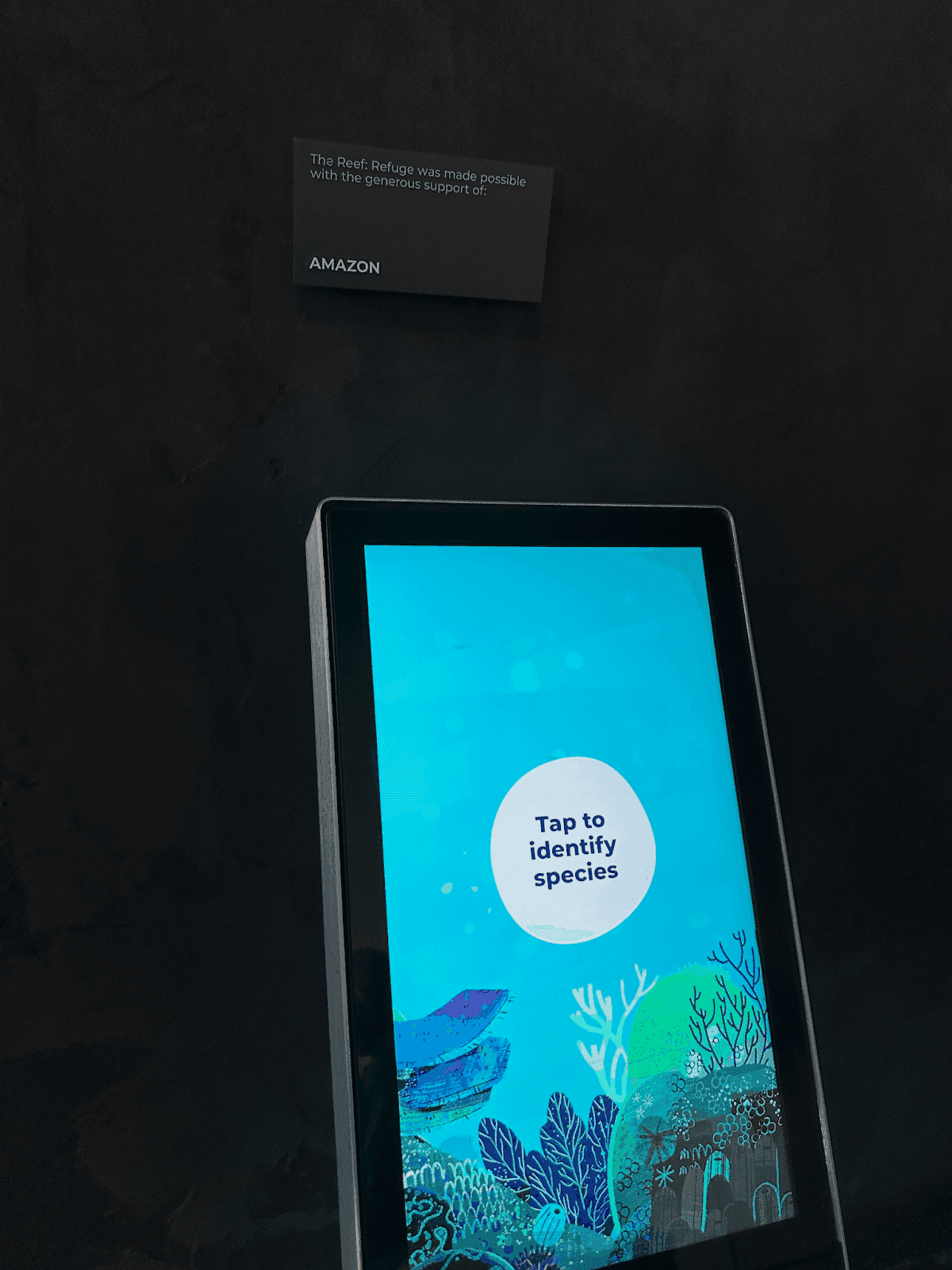
As we left the new part of the aquarium, we passed a wall of sponsors. My daughter stopped and pointed to the signage. “Look, Mom– Made possible with the generous support of Amazon.”
If you wish to celebrate our nation’s birthday with acts of resistance, here are some steps to get you started:
Download my popular Unplug EdTech Toolkit (at 3K downloads in the past several months and growing!) and decline the use of the 1:1 for the 2026-27 school year.
Think about change as a Jenga tower— in order to topple the EdTech tower, we have to pull out the pieces everywhere. If you’re passionate about public testimony, go speak at a school board meeting. If you like to form strong relationships and work with others, ask your child’s teachers how you can support them in reducing tech. If you like writing, put out some Op-Eds. It doesn’t matter what you work out; it matters that you do something.
Don’t just complain, vote. It does matter. A healthy democracy is of the people, by the people, for the people. And our voice is our vote.
Find your other fish. Check out groups like Fairplay’s Screens in Schools, Schools Beyond Screens, and Distraction-Free Policy Project to join the growing movement for change.
And if none of the above works for you, consider financially supporting the work of those who are willing to fight this fight, like becoming a paid member to my Substack or donating to nonprofits who spend hundreds of hours battling Big Tech.