

The Future of School is Tech-Intentional™
The best preparation for a digital future is an analog childhood-- at home and at school

Note from Emily: There is no question— the landscape around technology use in education is shifting dramatically and quickly. A few years ago, I began offering The Tech-Intentional™ School Certification. I realized that as schools started to experience increased pushback about EdTech they would need to redefine themselves in a way that promoted learning and protected children and teachers. In March of 2025, I delivered a keynote before the Filson Historical Society in Louisville, KY, on this topic and afterward, wrote this piece. But I knew it was still early and schools would need time (and continued pressure) to come around. Over the past year, inquiries have trickled in, but school leaders weren’t ready.
Until now.
I am honored to announce that the first Tech-Intentional Certified School™ in the world is here— the Manhattan Day School in New York City. In partnership with Manhattan Day School’s bold leader, Dr. Pesha Klentenik, who has spent the past few years laying the groundwork for this moment, I had the privilege to visit the school, observe their tech-intentional practices, and speak with faculty, parents, and staff. The following is the text of the talk I delivered to parents.
First Fish Schools require First Fish Leaders to become tech-intentional. This process is not simply a checklist or self-assessment. It is a deep and sometimes uncomfortable dive into both systems and our values to find a better way to prepare children for the future, through hard work, important conversations, and strong leadership. To learn more about how your school can become certified, please visit here.

Preparing Our Children for the Digital Future: A Case for the Analog Childhood
Delivered on Tuesday, May 19, 2026 at the Manhattan Day School in New York City
Good evening–
Thank you to Dr. Kletenik and the Manhattan Day School and to Tikvah for this opportunity to speak to you tonight.
I want to start with a story.
12-year-old Carley burst into my office with her backpack, clarinet, and school-issued iPad. She announced that she needed to work on a homework assignment for science.
She opened her iPad and started toggling. There were no physical books in her bag; the science textbook was actually a 400-page PDF. She opened it in one window, then opened Schoology, where her homework assignment instructions were posted, then opened an app called Notability, where she could type a response to the questions for the homework assignment, and finally, she opened a web browser.
I watched her navigate all these steps. Carley was in the accelerated learning program in her school and her cohort was piloting an entirely iPad-based curriculum. Trying to find the correct section in her science text– I mean, PDF– Carley scrolled with her index finger on the screen for a few minutes before growing frustrated. She couldn’t find the corresponding section to read that would help her answer the questions in the document. So she returned to the Notability app, copied the first question with her cursor, then pasted it into her web browser, and hit enter.
Google returned several answers. Without reading any of them, Carley copied the first one, then pasted it into the text box in her Notability app.
I stopped her and asked– “Do you know what plagiarism is?”
She paused and said, “Yes, but my teacher doesn’t really read our answers anyway.”
“Ok,” I said. “I can see it is frustrating to have to scroll through that long PDF. What about at least putting the answer into your own words and retyping it?”
“Oh,” she replied, holding the school iPad with an attached keyboard in her hands– “I don’t know how to type.”
I would like to tell you that this story happened recently. But this was over a decade ago, when I was working as an academic support coach after spending twelve years as a middle school English teacher.
This was an aha moment for me– when I realized the perceived benefits of technology that had been touted to me as a teacher in my professional development workshops for the previous decade had reached a tipping point– the technology was no longer a tool, serving a teacher or a student but was, instead, an impediment to the learning process.
Childhood in America: 2026
This past January, I was invited to testify before the United States Senate Committee on Commerce, Science, and Transportation. They asked me to “Summarize the impact of technology on childhood in five minutes.” No small feat.
I’ll paint the same picture for you tonight that I did for Senators that day: In America in 2026, children’s lives have been fundamentally changed by technology, not just in the home, but in schools as well. If we are going to address one, we must actually address both.
Today, American children aged 8- to 18-years-old average 7.5 hours a day on screens– outside of school hours.
Occupational therapists tell me they now have to teach young children how to turn the pages of a book.
Preschool teachers report that toddlers don’t like getting their hands dirty.
Young children are literally falling out of their chairs in classrooms because they lack the core strength to sit.
4-year-olds are showing clinical signs of addiction to screens– eyes glazed over when toys and physical books are present; eyes lighting up when a screen is produced.
A teacher told me that while assessing young children for kindergarten readiness, she wanted to see what letters and numerals they could name. When the four-year-olds got to “11,” however, many children said: “Pause.” (As in an “11” looks like what they recognize as a pause button on a screen.)
These same four-year-olds are now entering formal schooling where we are witnessing both a creativity crisis and a learning crisis.
A Creativity Crisis
Creativity is innate in children. Left to their own imaginations, most young children should be able to entertain themselves with minimal adult interference. Except that this experience too is changing. Young children, exposed to increased screen use in their early development, seek quick fixes, have shorter attention spans, and lack basic imagination skills.
One 15-year-old told me that the elementary school students she worked with in an after-school drama club, when she prompted them to “pretend to fly”-- asked her, “How?”

Creativity means “having an original thought.” Technology access in childhood does not enhance creativity; it kills it. Today’s tech titans had analog, play-based childhoods and send their own children to nature-based, low-tech schools.
When I first started this work nearly a decade ago, we were focused more on the amount of screens children were accessing after school and during weekend hours. We could work with parents on the home front and help them find non-screen ways to keep kids entertained. I wrote my first book about how to do this. The number of hours kids were on screens at home did seem concerning, but at least, we reassured each other, school remained a respite for developing minds. But at the same time as children were increasingly spending more time at home on personal devices, schools were also rolling out educational technology products.
A Learning Crisis
And as they did so, reading and math scores have plummeted.
Today, 90% of American schools now provide children with 1:1 internet-connected devices and rely heavily on EdTech products to instruct, assess, and grade.
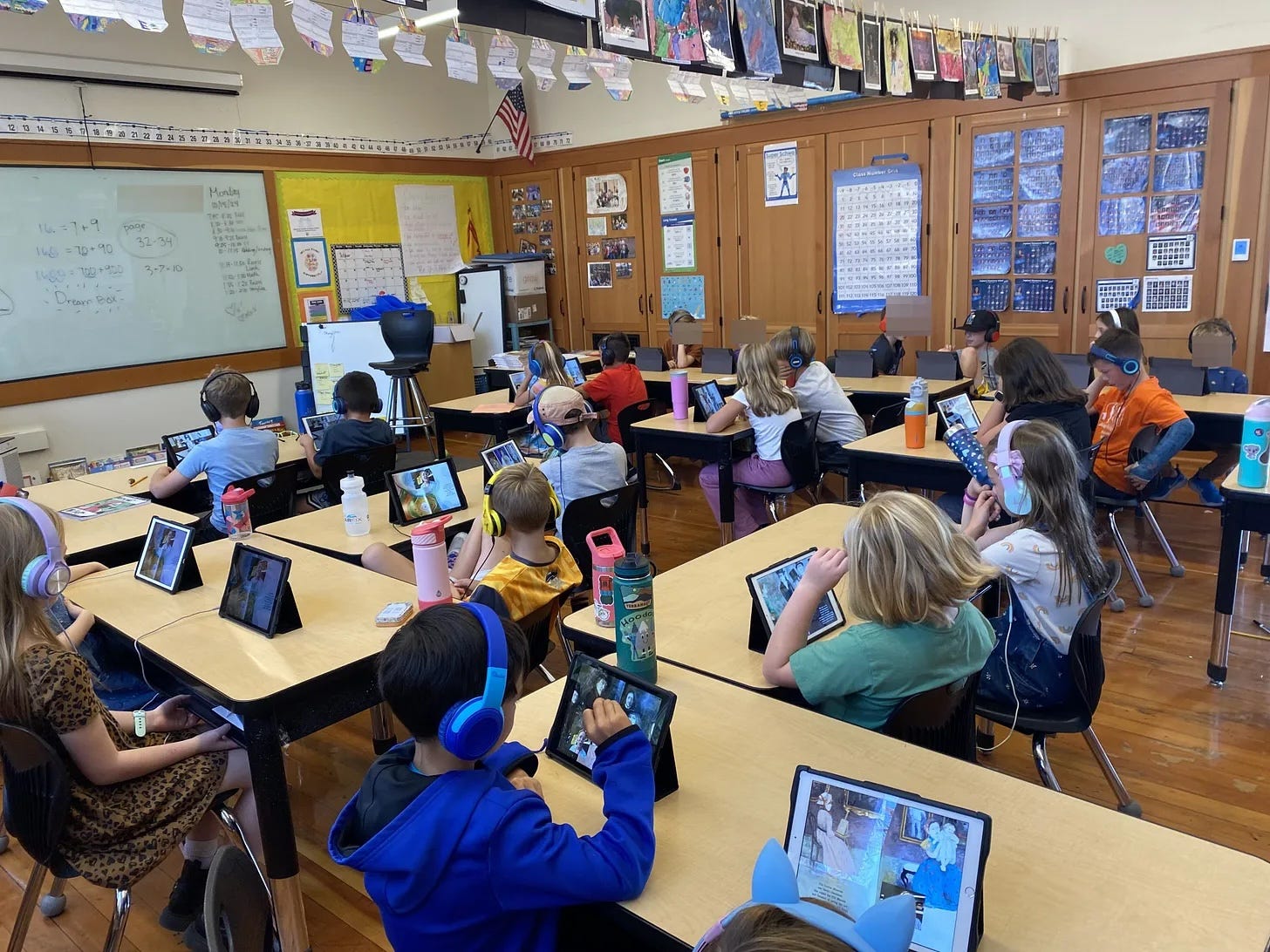
As one example of what a classroom looks like these days, here is a photo of second graders during reading time in a public school in Oregon:
Sitting right next to me during my Senate testimony was my friend and colleague Dr. Jared Cooney Horvath, whose testimony revealed a stark truth: Children today are less cognitively capable than we were at their age.
Additionally, Dr. Horvath’s research has found that in spite of all the technology we gave them in schools over the past 13 years, students today are also less digitally literate.
While it is easy to blame “just” the school laptops or “just” children’s personal smartphone use for these problems, the truth is much broader– it’s both. As one example, research by my colleague Dr. Jean Twenge, who also testified with me before the U.S. Senate, shows that in schools where students spend a lot of time using devices– personal or school-issued– for entertainment during the school day, test scores plummet.
The reality is that both parents and educators have work to do, and part of that effort starts with acknowledging that the goals of Snapchat and Meta are no different from the powerful EdTech companies like Powerschool and iReady– their existence depends on children using their product.
As I always say, EdTech is just Big Tech in a sweater vest. But these products used both at home and for school have unfortunately fueled a re-structuring of childhood around screens that has been catastrophic for children, families, and educators.
A Mental Health Crisis
As a result, kids today face a mental health crisis.
Screen use before two years of age is linked to accelerated anxiety by age 13.
Today, one in three teen girls has seriously contemplated suicide. The youth mental health crisis is so dire it elicited a warning from the surgeon general.
The question is no longer “What’s the problem?”
The question is now: “What will we do about it?”
How Did We Get Here? What Happened?
Both Big Tech and EdTech have hoodwinked us into thinking that without use of these products, our children will not learn; our teenagers will miss out socially; our teachers will not feel supported; and our students will not be prepared for the future.
This is not true. Instead, more than ever, parents and educators must partner together to advocate for what children need, and the answer to that is not “more technology.”
The winds are shifting. I know things feel qualitatively different today than they did even six months ago.
Parents who have made concerted efforts over the past few years to keep their kids off screens and prioritize play-based childhoods are shocked to send their five-year-olds off to school where they are handed an internet-connected iPad.
Parents who have “waited until 8th” only to face relentless pressure from their 13-year-old that without a smartphone they will be “left out” of all social interactions.
Teachers, overwhelmed with the continual demands to do more with less, are offered “new” AI-based products to “streamline” their workflow, instead of receiving support in the form of smaller classes, more staffing, fewer tests, or simply time and space to do the work that comes with being a teacher and that allows them to learn about their students in thoughtful ways, not quantified by some system or diagnostic test.
And school leaders, compelled by the state to provide evidence of learning progress were sold a story by EdTech companies pitching comprehensive products as solutions, but which now have school systems so locked up into digital ecosystems that when things like the recent Instructure data breach occurs, entire institutions are crippled.
This isn’t what education is or should be.
2012: Two Major Shifts
Around 2012, when I was still a classroom teacher, I witnessed two major shifts:
First, my middle school students were increasingly accessing social media platforms– either on a home computer or, more frequently, a personal smartphone. Our school had a “no phones” policy until the final bell rang long before it was a popular thing to do, and for the most part, it worked well on campus. But I would hear conversations daily from students about the drama that had occurred in a Facebook group the night before, or see that kids were staying up way later than usual to scroll and message friends on social media, or even that their parents were less engaged because they were consumed by their own devices.
Secondly, as a teacher, I was increasingly asked to post my student’s grades and homework assignments in a digital portal. When they would come talk to me about a grade or missed assignment, I was told to tell them to “Check the portal.” Parents now had access to this online grading system, and many parents had their own smartphones, so they could check often, and my email inbox filled quickly with messages from parents wanting more information about specific grades, to ask why a child’s assignment wasn’t graded, and more. Instead of my students coming directly to me to ask for support or information, parental access to grades now triangulated the process.
Nearly 15 years later, this has become the norm– children with internet-connected devices; teachers tethered to screens to teach, learn, prep, grade, and communicate; and parents, with 24/7 access to information about their child.
Initially, intentions were good: teachers wanted parents to have insight into their child’s schoolwork; parents wanted to know how their child was doing in class without having to bother the teacher; and students could easily look things up if they were home sick, for example. None of these are inherently bad things.
But the road to hell is paved with good intentions.
Here is how I know.
What Going Viral Really Revealed
In March, I delivered a speech at Tikvah’s Marom conference in Miami. It’s where I met Dr. Kletenik. Following the speech, I participated in a panel conversation and we took questions. In my response to one audience member’s question, I said the following: “I’m going to say something bold here– I don’t think parents should have access to online grading portals.” I went on to explain why– about the changes I had witnessed in my students and the way constant parental access drove parents to constantly check and children to feel increased anxiety and pulled teachers away from teaching. I said to the audience– “I think we can know less and still be good parents.”

I stand by those words today, but when I posted a clip of this on social media, I’m not exaggerating when I say it exploded. I woke up to the video having been viewed over a million times and over 400 comments. It’s now past 9 million views, and I had to shut off the comments and untag myself from other people’s reposts.
What’s interesting about this is not that something that I thought was not terribly controversial went so viral or that it invited the usual toxic misogynistic and anti-Semetic backlash– such is the nature of social media– but rather how many of the comments involved hostile and vitriolic finger-pointing from teachers to parents and parents back to teachers. It was sad to see this loss of trust between the two groups of people who are best positioned to provide support and guidance to children during their early developmental years.
Beware the EdTech Industry Rebrand
We all have a lot of work to do. Schools aren’t always perfect. Parents have made mistakes. But the common enemy isn’t each other.
In fact, when we go after each other, we have to ask, Who benefits?
Unfortunately, it is not children. It is not teachers. It is not parents. It is primarily the tech companies who want to put their products into the hands of children in the first place, because they are beholden to shareholders and engagement metrics, not education and child development. When teachers and parents and admins go after each other instead, it serves the industry’s goal and takes the spotlight off the very real harms that are occurring.
In fact, I am noticing a big shift in how educational technology companies are attempting to reposition their products and services as “distinct” from “entertainment technology”-- you know, the kind that parents provide and is actually harmful. “It’s the parents’ fault,” they argue. “They’re giving the kids all this bad screentime; we offer the good kind.”
But this is misleading, and intentionally so.
We can’t fall for this– EdTech is Big Tech. It’s not solely the content– the business models are identical and out of alignment with what children need. We can’t let corporate interests divide or district us.
We have to stop pointing fingers and blaming entire groups, because it solves nothing, gets us nowhere, and only weakens our efforts to do what is right by children.
Where Do We Go From Here?
How do we begin to reclaim both childhood and education from the influence of Big Tech?
I want to spend a few minutes talking about the parent side of this. Because this isn’t a kid problem; it’s an adult problem that is impacting children.
If you’re a parent, does this sound familiar?
“Our biggest stressor is getting our kids to turn off screens when asked.”
“I’m tired of the battles…I’m very nervous about the path ahead. It’s unfair that this all rests on parents.”
“Even with all we are doing, we will struggle with the addictive nature of screens, our child’s belief that her peers get more access than she does, and it’s like a part-time job for us to stay on top of it all. It’s exhausting.”
One of my foundational beliefs is to “replace judgment with curiosity.” Twenty, ten, even five years ago, we did not know all the things we know today about screen use and children. Now we have new information and with that information, we can make different choices.
Let’s talk about the two areas that have been most impactful.
Persuasive Design
By now, this term has become more mainstream. When I first started this work, it was not. “Persuasive design” simply means using the power of psychology with technology to change our behavior. We experience this all the time– infinite scroll, autoplay on the next episode, the “like” button. It isn’t hard to see how much of a pull this has on us as adults, with our fully formed brains. We are often terrible users of social media and phones.
When it comes to children, it is far more challenging. A child’s brain is not an adult brain. They are much more defenseless to these persuasively designed products and we, as adults, must fight to protect them.
Executive Function
One way we can do that is by ensuring our children have plenty of opportunities in childhood to develop certain skills, and the most important set of skills we want children to have time to develop are “executive function.” Executive function skills are housed in the prefrontal cortex of our brains, which also happens to be the last part of our brain to fully develop. This is why, from a brain development perspective, “childhood” can last well into our 20s or even 30s! Executive function skills include things like planning, prioritizing, organization, cognitive flexibility, emotion regulation, and more. These are foundational skills that allow us to navigate all sorts of situations– school, family, friendships, work.
When it comes to screen use, however, excessive use and the persuasively designed elements of the apps and games and products we (and our children) are using can interfere with healthy development.
We can see this happening– our child spends time on an app or game or platform, we ask them to stop, they have a big reaction. The next time we ask, that big reaction seems to come more quickly or more intensely.
This is because our child’s brain is adapting– it feels good when we win a game, get a like, receive a comment, earn some points– so we want to keep those good feelings going. But we have to remember, these products, apps, and games are designed to do just that: to hook and hold our attention.
So when a parent comes to take away the iPad or tells a child to turn off the game, a child’s brain is going to dislike that. We are interrupting that feel-good experience.
It’s not just children, of course. How many times have we as adults felt irritated when someone interrupts us mid-scrolls? If adults are addicted to their phones and cannot resist this cycle, how on earth can we expect children to!?
In fact, computer scientist Edward Tufte has said, “There are only two industries that refer to their customers as ‘users’: illegal drugs and software.”
Our children aren’t being stubborn; they’ve been hooked.
It isn’t you vs. your child, it is you versus a hijacked neural pathway.
And that is not a fair fight.
What Really Matters?
We do.
We’ve established that this is not a fair fight. It is not our fault as parents that these products are designed to be addictive. But it is our responsibility– now that we know this– to do things differently.
And there are two clear areas where our efforts really have an impact;
Our own use of screens.
Our relationships to our children.
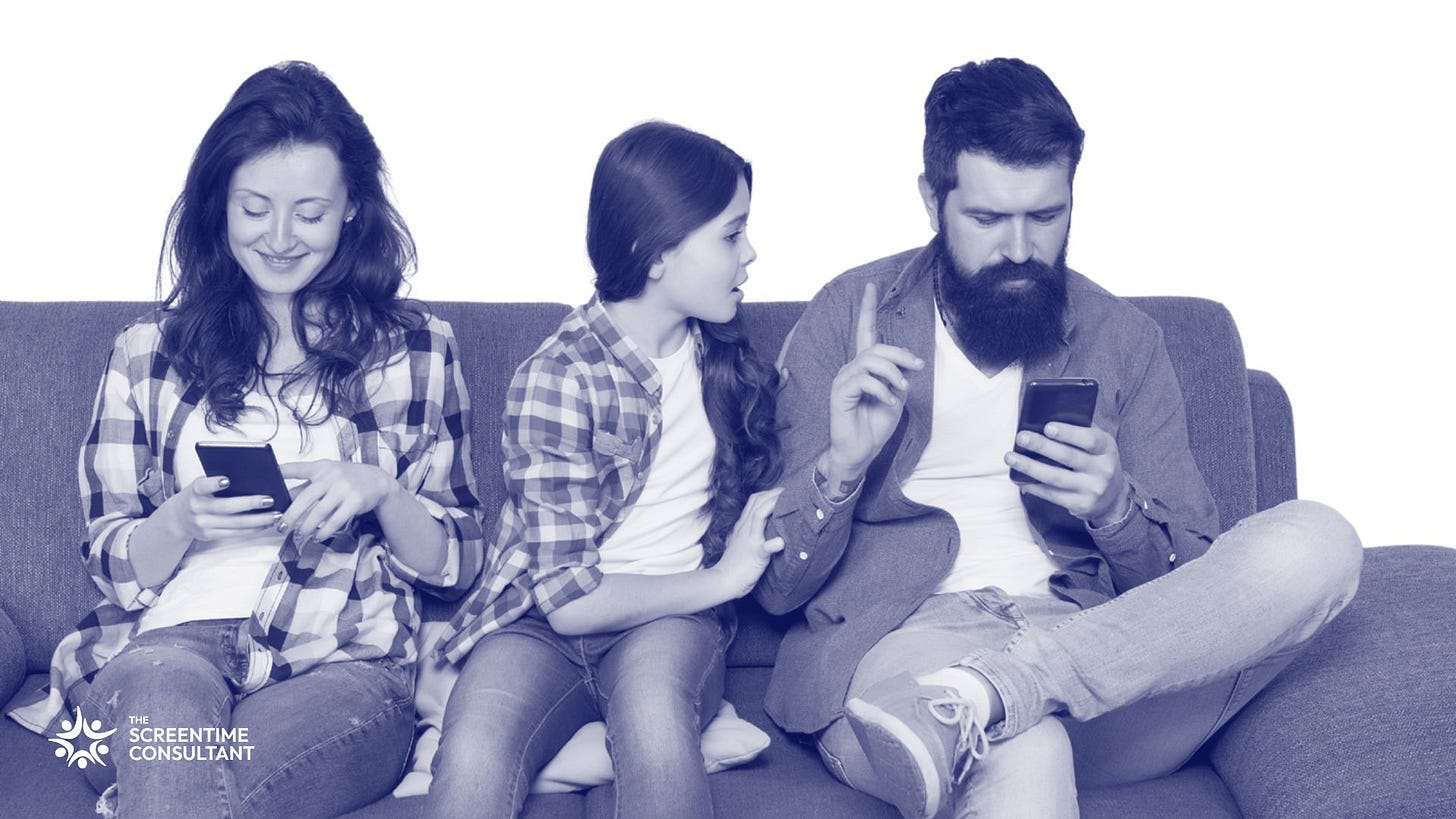
I am not here to shame and blame parents. We won’t move the needle at all if we start pointing fingers. But what we do matters.
This may be a familiar scene– you’re talking to someone, their phone pings, they glance down, and all of a sudden, you can tell they aren’t listening anymore. There is actually a term for this– “phubbing”-- which is “phone” plus “snubbing.” As adults, we may find this rude behavior. So how do our children experience this? What message are we sending when we let our phone interrupt a conversation we’re having with our child?
When we are distracted by a message or something on our phones mid-conversation, we are giving someone else who isn’t even in the room permission to interrupt us.
Recent research by Dr. Jason Nagata found that parental screen use, screen use during meal times, and screen use in the bedrooms were associated with greater teen screentime and problematic social media, gaming, and smartphone use.
The good news is that that same research found that when parents monitored and limited screen use, problematic screen use dropped.
Two Most Frequently-Asked Questions— and the Questions We Should Be Asking Instead
I’m frequently asked these two questions:
How much screentime is “too much” screentime?
What parental controls should I use?
Briefly, the answers are:
A little is okay, a lot is too much
Parental controls are not the panacea we want them to be. Otherwise, I wouldn’t be asked this so much.
Instead, I’d like to invite you to ask two different questions– questions that will be far more useful as we navigate screentime on the parenting side.
Do I know what my child is doing online?
Do I have a strong relationship with my child?
What is powerful about these two questions is that they depend on each other: to know what our child is doing online, we must have a strong relationship with them. To have a strong relationship with them, we must know what they are doing online.
I realize this is much easier to say than to do. But parenting is not a single sprint; it’s bursts of adrenaline followed by crushing fatigue and the race is actually a multi-year marathon sprinkled with adolescent sass and teen malaise. This is normal. Nothing about parenting is smooth or easy, but things are smoother and easier when we have a solid relationship with our children.
Building a strong relationship with our children will come from frequent conversations, listening more than talking, asking non-judgmental questions, being curious, using phrases like “I notice…”; “I wonder…”; “Tell me about...” in side by side, non-confrontational moments.1
The 3 Habits of Tech-Intentional Parents
I would like to make sure that I am leaving you with concrete, actionable steps that will help you on the home front support your child around screen use. This isn’t about blaming ourselves for not knowing all this, or judging what we’ve done (or haven’t)-- this is about taking new information and applying it because we know it will benefit our children.
Let’s talk through these.
Habit #1: Understanding Scary vs. Dangerous
I like to pose a question to understand this habit: What is scarier? A shark or a bathtub?

Most likely you are thinking “shark.” Not many people fear their bathtub (if they’re lucky enough to have one in New York City.)
If I ask you which of these two is more dangerous, how would you answer?
Here you may say “shark” again, but let’s break this down by looking at our odds of dying in a bathtub vs. a shark attack.
Our risk of dying in a shark attack is 1 in over 4 million. But our risk of dying in our own bathtub is about 1 in 10,000. So why do we fear sharks, but not bathtubs? Why are there movies about sharks and weeklong series on sharks, but not bathtubs?
Let’s bring this back to parenting and screentime.
A few years ago, Pew Research asked parents: What are your top three parenting fears?
Parents answered:
Our children’s mental health
Bullying
Kidnapping
But one of these things is not like the other. We very clearly have a youth mental health crisis in this country. Children who are bullied will likely be a part of that crisis. But we do not have a kidnapping crisis in America. How then is this one of the top 3 parenting fears?
Kidnapping is a scary thought– but it is not a dangerous reality. In fact, my friend and colleague Lenore Skenazy2 talks about this– if you wanted your child to actually be kidnapped, he would have to stand outside on the street corner for 750,000 years.
But because kidnapping stories– though extremely rare– make for great clickbait and social media attention-grabbing posts, and we adults, as we’ve already established, spend a lot of time on our own devices, we are constantly bombarded with 24/7 alerts and “breaking news” stories that prey on our own anxieties about the world being a dangerous place and lead us to believe that in order to keep our children safe from kidnapping, we should give them smartphones.
But take this one step further: if we give our children smartphones, especially at younger ages, we are increasing their risk of the other two parental fears: bullying and youth mental health.
So when I talk about understanding the difference between “scary” and “dangerous”-- this is what I mean.
Kidnapping is scary, but not dangerous.
Internet-connected smartphones and social media in the hands of children are not just scary, they are dangerous.
Habit #2: Choosing Mentoring Over Monitoring
Part of having a good relationship with our children, in addition to worrying about the “right” things, is understanding that our mentorship is far more effective than monitoring.
I know I just said that parental controls aren’t the panacea we want them to be, but then told you that you have to know what your kids are doing online. So how do you do that without monitoring controls?
Through constant conversations with your children, avoiding reliance on more tech products to solve a problem tech created, and seeing parenting as teaching. Kids will make mistakes (so will we!). That’s normal. Our job is to help them navigate what to do next.
Dr. Devorah Heitner describes this as choosing “mentoring over monitoring.” Relationships are rooted in trust and communication– when we use tech to surveil our children, especially without telling them, we erode that trust.
If you have concerns about what your children are accessing, or what they might access or encounter, then I invite you to reframe limits and delays as this:

Think of delaying or limiting phones or social media not so much as the deprivation of something, but instead as a gift.
The gift to experience childhood in the 3-D world, with human friends and social play.
The gift of not having access to all the information in the world all at once. As one of my favorite quotes states, “trying to get information from the internet is like trying to drink water from a fire hose.”
The gift to make mistakes free from the fear of being recorded or uploaded to a social media platform.
The gift to develop the skills that will set our children up for success as adults– the executive function, empathy, critical thinking skills that they will need to navigate any situation.
The gift of learning to sit with discomfort– maybe feeling like the “only one” without a phone. Discomfort isn’t trauma; it’s an opportunity for building resilience.
Habit #3: Live Your Life Out Loud
The final habit of a tech-intentional family is “Living your life out loud.” I love this one. “Living your life out loud” means narrating what you do, as you do it, any time it comes to screen use. While we can eventually invite our children to join us in this, this is a habit that starts with us. It might look or sound like this: “I’m reaching for my phone to text your friend’s parent to see what time we’re meeting at the park”; “I’m looking at a recipe to get dinner ready”; “I just got a notification from work and I need to respond to it– I’ll be available as soon as I’m finished.” You can explain this to your children– “I’m trying this new habit. You can help remind me if I forget!”
This narration is observational at first, but we can add in the emotional impacts too: “I’m standing in line for coffee and feel bored so I’m scrolling through Instagram.” By saying out loud what experiences we have as parents around screen use, we are showing our children that this isn’t easy for adults either, that we can apply feelings to the impact our phones have on us, and that we’re also fallible works in progress.
We can’t do this all the time, obviously, but I invite you to start trying. Aim for the 80/20 rule– 80% of the time we’re striving to be our best parenting selves; 20% of the time we are going to make mistakes or forget. That is okay, because that is healthy modeling for our children too.
Don’t expect your children to get on board with this right away. In fact, they may think you’re crazy when you first start doing it, especially if it’s a new habit. Here’s how you know it is really working, thought– the kids start rolling their eyes. That’s a parent’s sign that something is getting through.
If your children start to live their life out loud– or even better, when they call you out for not doing it– celebrate it: “Thanks for the reminder”; “Thank you for living your life out loud!” Where attention goes, energy flows.
One final prompt that can help solidify all of this is the phrase “I forgot to teach you.” These words have the power to deescalate a tense situation, removing feelings of blame or shame, and empower parents to step into their role as mentor. After all, the root of the word “discipline” is “to teach.”
Coming Full Circle: Parenting, Education, Screentime, and Children
So let’s bring this full circle: it is not our fault that the internet-connected products used for entertainment, communication, and education are so persuasively designed that children can become addicted, but it is our responsibility as adults to do things differently now that we know the risks of harm.
This is true for parents, for teachers, and for school administrators.
We are the adults in charge. We are the ones who can decide to do things differently. We are the parents who can scroll less on our own devices and delay access; we are the teachers who can return to evidence-based learning methods like handwriting and physical texts; we are the leaders who can push back on the influx of for-profit technology-based products into our classrooms.
Increasingly, screen-free childhoods and phone-free school movements are gaining traction, and these efforts are incredibly important and good– but it is important to note that there are– and have always been– two digital elephants in the room:
The devices our kids access because we as parents give them access (phones, watches, gaming consoles); and
The internet-connected devices that schools hand out in the name of education.
If we are going to address one elephant; we must address both. If smartphones are harmful to children’s social and cognitive development, then so are internet-connected laptops for school.
Which brings me to the work I am doing with Manhattan Day School educators and staff.
In my view, just like the role of parenting in a child’s digital life must be tech-intentional, the future of school is Tech-Intentional™ too.
Being a tech-intentional school means using screen-based technology only when it enhances, nurtures, and supports an educational community, in alignment with a school’s mission and values; and resisting, delaying, and limiting screen use that interferes with healthy mental, physical, cognitive, social, spiritual, and emotional development.
The 4 Guiding Principles of a Tech-Intentional School
A tech-intentional school follows four guiding principles:
Children need technology education, not educational technology
Children need social interaction in the form of non-digital, unstructured play and real-world skill-building with peers and teachers
The most advanced technologies used in a classroom are paper, pencils, and people.
Children’s development, safety, privacy, and right to an education are always prioritized.
In other words, when it comes to screens, being tech-intentional in the home AND at school means:
Less is more
Later is better
Relationships and skills first
The First Ever Tech-Intentional Certified School
I am honored that Manhattan Day School is leading the way by becoming the first school in the world to become Tech-Intentional™ Certified. I spent all day yesterday visiting classrooms, talking with educators, and learning about the work that Dr. Keltenik has spear-headed here. She courageously paved the way to certification by eliminating the 1:1 personal devices and implementing policies around staff personal phone use, for example, and she remains open and eager to explore further changes, including partnering with parents on screen use at home, because she knows the positive impact it will have on her students. This is what strong leadership looks like.
I call my Substack “First Fish Chronicles” because, in the ocean, when a school of fish are swimming and they need to change direction, do you know what starts that shift? It takes one fish to peel away, but the whole school won’t start to shift until a second, third, or even fourth fish pulls away– and then the rest of the school will follow. Being a first fish takes courage, but once one starts the process, others will soon follow.
By becoming the first Tech-Intentional Certified school, Manhattan Day School is a First Fish school. Dr. Kletenik is a first fish leader. Some of you are first fish parents, delaying access to smartphones, limiting screen use at home, and putting your own phones down when your family is together. When we make these changes, others will follow. I know more fish are coming. I welcome them.

The First 4 Questions We Must Ask
So tonight, I want to leave you with four questions that should be asked of any adult handing any child an internet-connected device– either at home or at school:
Is this effective?
Is this safe?
Is this legal?
Is this better than a human?
Right now, the answer to all of these questions is no. We need to get to Yes. Four of them.
Another 3 Questions We Must Ask
I wrote about this extensively in my book, but there are also three more questions to ask any time we decide to hand over an internet-connected product to children:
What do we gain?
What do we lose or replace?
What do we model?
A tech-intentional school is constantly asking these questions.
To do this requires a partnership. Schools do not have oversight into what children are doing on screens in the home, just as parents do not have knowledge about what their child is doing on internet-connected devices at school. Both matter. And both require concerted effort, change, and course-correction to protect children. Manhattan Day School is taking those steps in classrooms; parents can support these efforts by following through on screen use oversight at home.
The benefits of keeping our children off screens at home and at school are vast. There will be time for technology in their adulthoods. But when it comes to preparing children for the future, there is no opportunity to go back and reclaim the growth and foundational learning that occurs in childhood, while brains are still developing.
The skills children need to be successful in the future are not digital; they are human.
Thus, the best preparation we can offer our children for a digital future is an analog childhood and an analog classroom, and children thrive when parents and educators fight for them, together.
It has been an honor and a privilege to be your teacher this evening.
Thank you.
I write about all of these things in more depth in my book, which you can find here or anywhere books are sold.
Fun fact: Lenore Skenazy was in attendance at this talk! She’s the best.