

An Uncomfortable Union
When the organizations who exist to protect the teaching profession instead get cozy with the companies who seek to undo them


For our readers who prefer to print or email a PDF of our essays, here is a downloadable link:

In our last essay from the Reckoning Series, we took a deep dive into the Big Tech ties behind a private school model, Alpha School, that uses AI tutoring for academics rather than human teachers. (404 Media also wrote a blistering piece on Alpha Schools– definitely worth a read.)
This week, we look at how EdTech and AI are worming their way into public schools by way of powerful teacher unions such as the American Federation of Teachers (AFT) and the National Education Association (NEA).
Big Unions + Big Tech = Big Problem
Twenty years ago, in an essay for the American Federation of Teachers’, historian and educator Diane Ravitch wrote about how teachers’ unions are good for teachers and the public because they “protect teachers’ rights, support teacher professionalism, and check administrative power.” This is an essential service, and teachers unions are critical to great schools.
But today the organizations charged with protecting teachers are partnering with and taking funding from companies whose ultimate goals are to push AI in schools and eventually replace teachers. This is deeply problematic (and not exactly strategic).
An AI Academy for Teachers, Funded by AI Companies
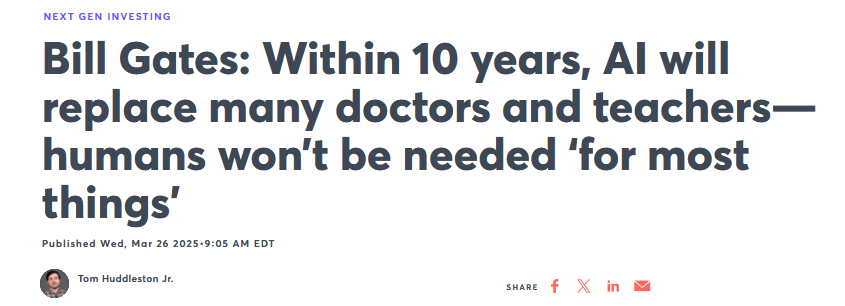
In the summer of 2025, the American Federation of Teachers (AFT), the second-largest U.S. teachers’ union, announced that it was creating an A.I. training center for educators, the National Academy for AI Instruction, in partnership with OpenAI, Microsoft and Anthropic– some of the biggest, wealthiest, and most powerful tech companies on earth. The academy will be located in Manhattan with the stated goal of training educators so that “artificial intelligence is taught and integrated into classrooms across the United States.” Such chatbots can produce “humanlike essays, research summaries and class quizzes.” (Isn’t generating an essay a student task? Why would a teacher need to generate an essay?)
OpenAI, Microsoft and Anthropic, three of the leading chatbot-makers, are generously providing $23 million in funding for this center. Not too dissimilar from Phillip Morris funding courses on treating nicotine addiction.1
OpenAI believes “more usage of AI in the world will lead to good, and [we] want to promote it.” In a recent New York Times article about this joint venture between AFT and OpenAI, Chris Lehane, OpenAI’s chief global affairs officer, stated he believes that schools can add a fourth “R” to the old adage of “reading, writing, and ‘rithmetic”: “learning how to use A.I.” (Though we fail to see how “A.I.” would be an “r”-- “really bad idea”, maybe? Or “arrrtificial intelligence”? Like a pirate?)
Randi Weingarten, president of the American Federation of Teachers, sees the National Academy for AI Instruction as “an innovative new training space where school staff and teachers will learn not just about how A.I. works, but how to use it wisely, safely and ethically.”
But what we have come to see from our experiences in classroom settings, the stories about chatbots harming children, the redefining of teachers as guides, plus our own research on AI-driven Alpha schools is that there isn’t a way to use AI ethically, because AI models are built on plagiarized work, problematic content, and serve to benefit only a handful of powerful companies, not children, teachers, or schools. Ms. Weingarten should know and understand this, especially if she considers herself an educator.
“There isn’t a way to use AI ethically, because AI models are built on plagiarized work, problematic content, and serve to benefit only a handful of powerful companies, not children, teachers, or schools.”
-Emily Cherkin and Denise Champney
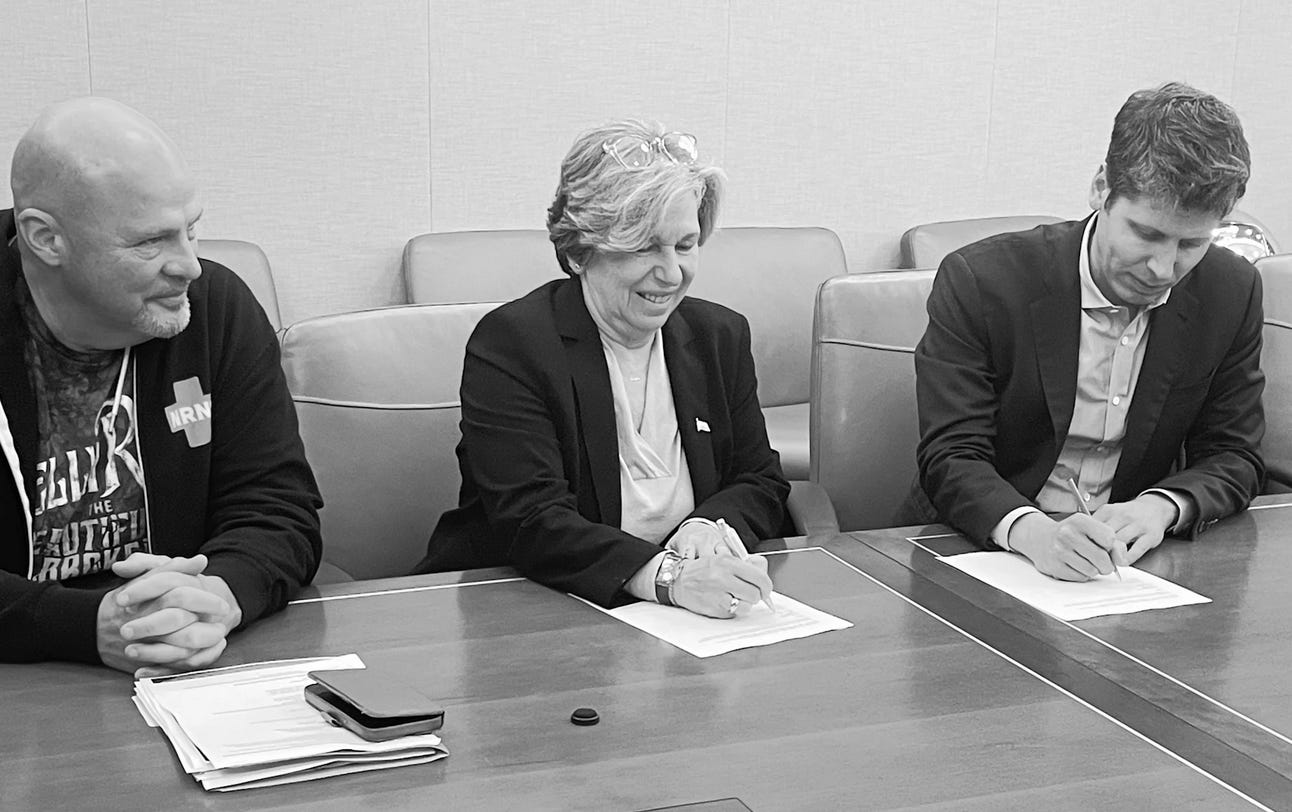
Ms. Weingarten doesn’t seem too concerned about this partnership with OpenAI. In fact, she looks downright gleeful signing this agreement alongside Michael Mulgrew, President of UFT, and Sam Altman, the CEO of Open AI, on June 10, 2025:
Unsurprisingly, Sam Altman sees nothing wrong with deploying AI products into education. Like many who argue that the best way to teach children about social media’s pitfalls is to “let them learn to use it safely,” Altman ignores the dangers of his products for children because, well, he’s incentivized to ignore them.
Follow the Funding…Way Back
Today, Microsoft is one of the companies funding the National Academy for AI Instruction. Microsoft is also partnering with the other major teachers’ union: the National Education Association (NEA), who recently received a $325,000 grant from Microsoft to “expand AI literacy and leadership” and provide educators an opportunity to “inform the development of Microsoft AI tools.” (Note from us: If teachers are going to use these tools, shouldn’t the tools already work? Aren’t these LLMs training on teacher-created content without their consent? Isn’t this asking teachers to do the work that technologists should have already done and putting teachers’ jobs on the line for it?!).
NEA president Becky Pringle defends these partnerships, claiming “this technology will continue to fundamentally change the way we teach and learn,” but she means this as a good thing. Like Altman and others, Pringle thinks students and educators need to “have agency” with this technology and that means accepting that students and educators can’t be “passive users.” (Just more variations on the pro-AI claim that “the toothpaste is out of the tube” and “we have to learn to use it because it isn’t going anywhere.” We’re getting tired of these.)
Given the horrifying picture we painted in our essay about Alpha Schools (and furthered by 404 Media’s recent coverage), we fear Pringle’s claims that AI will fundamentally change teaching and learning are accurate– just not in the way she hopes and very much in the ways we fear.
You might recall that the morning of Emily’s Senate testimony in January, a group called the Consortium for School Networking (CoSN) sent a letter to Chairman Cruz and Ranking Member Cantwell in an attempt to deflect responsibility for harms caused by technology products in school and to argue that there is a difference between “unsupervised, entertainment-driven technology use at home” and the “intentional, monitored, and carefully curated use of technology in schools.”
Both the AFT and the NEA signed this letter.
A Strategic Error
Another signatory on this letter, the International Society for Technology in Education (ISTE), “the largest provider of AI professional development,” has also been working alongside the NEA to implement an AI learning series to help educators “learn to integrate AI tools effectively and ethically into teaching, learning, and administrative processes while fostering AI literacy among students” (there’s that pesky word “ethically” again). According to their website, in merging with the Association for Supervision and Curriculum Development (ASCD), ISTE+ASCD bring educators together to “enhance learning and prepare students to become the next generation of AI designers and problem-solvers.”
You know– what all parents hope for their second grader.
Of course, follow the funding and see the list of sponsors and partners for ISTE+ASCD’s annual conference– “more than just supporters…active participants and contributors to our community…[who] play a vital role in helping ISTE achieve its mission”:
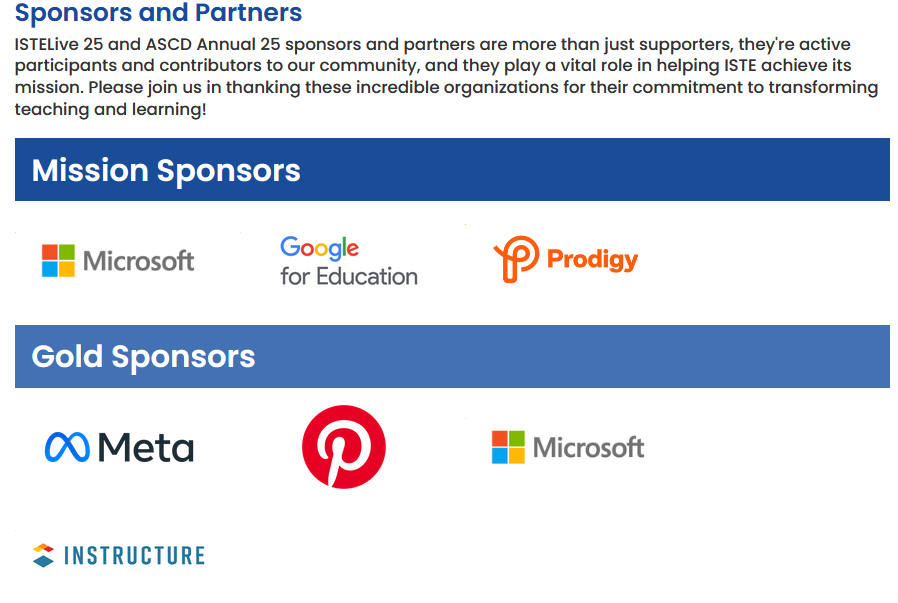

As their name suggests, ISTE takes funding from Big Tech and has a financial motive to make sure teachers are trained in their products. In the fall of 2024, ISTE+ASCD announced that Google will invest $10 million to “support efforts to provide AI skills training to educators and students across the country.”
In July of 2024, the NEA released their own Statement on AI in Education and lists as the first principle: “Students and educators must remain at the center of education.” Yet the NEA, along with the AFT, continue to actively partner with organizations like ISTE and CoSN and tech companies like OpenAI, Google, and Microsoft whose business models run counter to childhood, teaching, learning, and education.
As Emily has written about previously, the AFT, the NEA, and the United Federation of Teachers (UFT), are all partners in creating the National Academy for AI Instruction. How can these powerful unions, who receive millions of dollars yearly in mandatory annual dues from the educators they reportedly represent, work with companies who are working at a furious pace to replace them? This seems diametrically opposed to their original role of protecting the teaching profession.
“How can powerful teachers’ unions, who receive millions of dollars yearly in mandatory annual dues from the educators they reportedly represent, work with companies who are working at a furious pace to replace them? This seems diametrically opposed to the union’s original role of protecting the teaching profession.”
-Emily Cherkin and Denise Champney
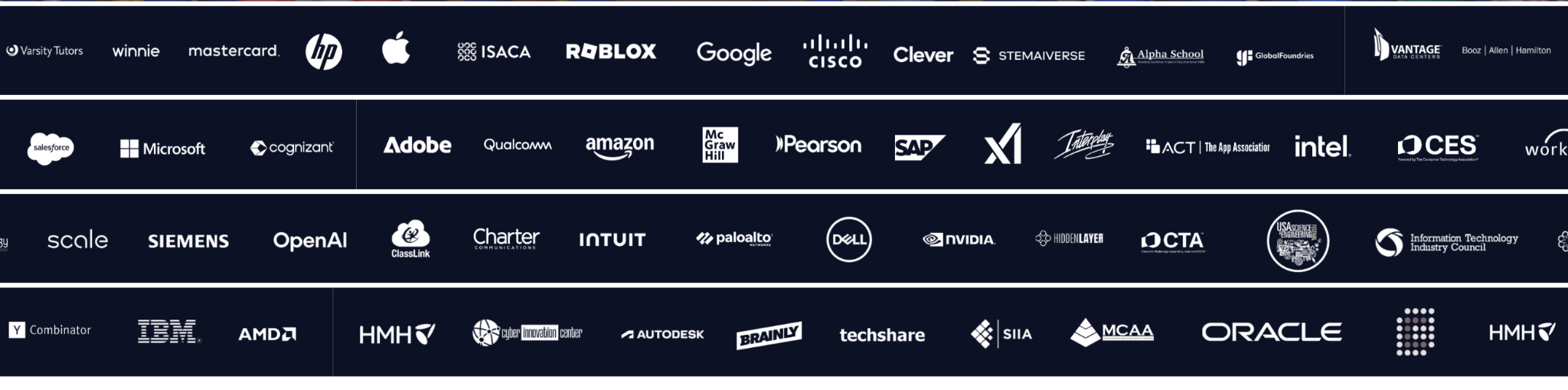
Unfortunately, technology companies stand to gain a lot from shoving AI products into education. And of course, these AI products make existing EdTech products even worse. The recent White House “Pledge to America’s Youth: Investing in AI Education” has been signed by Microsoft, OpenAI, and Alpha Schools, as well as Meta, Roblox, and Snap Inc. These are not companies associated with child well-being; if anything, they’ve been connected to serious and significant harms to children.
So why are they supporting the adoption of AI technologies in schools? Because these signatories stand to profit significantly from such action, in spite of what most parents (and teachers!) want for children.
Unions aligning themselves with AI companies is a strategic error. Instead of advocating for teachers, these organizations are partnering with companies whose mission is to replace their members.
What We Can Do to Stop This
History has shown that when teachers use their voices and band together, they are a powerful force to reckon with. Between 2009 and 2014, the AFT received almost $11 million from the Gates Foundation, but union members initially pushed back against Gates meddling in education and influencing teacher evaluations, which understandably bred distrust from teachers. At the time, AFT president Randi Weingarten announced at the Network for Public Education 2014 conference in Austin that the AFT was cutting ties with the Gates Foundation, demonstrating the power of teachers’ voices when they banded together.
There is a reason we will always need human teachers– even if and when children use technological tools in the classroom (and that would look very different from the current EdTech landscape). Neuroscientist Jared Cooney Horvath has talked about one of the most important components children need to learn: empathy– which requires two interacting human brains to develop.
Teachers do still matter and our role is even more critical now. Sadly, many teachers are leaving the profession at increasing rates. While there are many reasons that are contributing to the mass exodus of teachers from schools, the role of excessive technology use in schools cannot be overlooked. Technology companies want us to believe that the solution to ballooning class sizes is more tech in the form of these “wonderful” AI tools and chatbots with “potential,” but nothing could be further from the truth.
As educators, we can’t forget why we joined this field in the first place: to nurture, educate, and inspire children. Those things don’t happen when a child is staring at a screen– they happen, as Dr. Horvath explains, when two humans interact.
“Technology companies want us to believe that the solution to ballooning class sizes is more tech in the form of these ‘wonderful’ AI tools and chatbots with ‘potential,’ but nothing could be further from the truth. As educators, we can’t forget why we joined this field in the first place: to nurture, educate, and inspire children. Those things don’t happen when a child is staring at a screen– they happen when two humans interact.”
Emily Cherkin and Denise Champney
We can’t continue to let an entire generation of children serve as unwitting participants in an AI experiment. It is time to get back to what we know works and restore childhood and learning in ways that allow children to flourish and develop the way humans should– by working with real people in the real world, not with robots in an artificially induced one.
Today in 2026, educators need to find the same outrage that drove the AFT to separate from the Gates Foundation in 2014 and demand that union organizations cut ties with tech companies who are actively working to replace them. Teacher voices must join parent voices to stop AI from further destroying education and fight to preserve what matters most to children in a classroom– actual human teachers.
“Another course, called Nicotine Misperceptions, dismissed the adverse effects of nicotine on the developing teenage brain, stating that ‘none of this has ever been demonstrated in humans,’ despite copious human data to the contrary.”
 | A guest post by
|