

Beware the EdTech Industry Rebrand: Part 2
Extreme Makeover: EdTech Edition (ft. ISTE)


In Part 1 of Beware the EdTech Industry Rebrand: Extreme Makeover: EdTech Edition, we highlighted how the EdTech industry is not only aware of the growing grassroots backlash to their products, but attempting to reframe the narrative and cast themselves in a more favorable light.
We can see right through it.
“Screenwashing”: Out, Out Damn Spot
The backlash to EdTech is not actually about “screentime” (too much vs. too little). The backlash is in response to the fact that the business model of Big Tech and EdTech companies is in direct conflict with healthy child development.
Parents and schools want advice about how to use technology with children–that’s a good thing. Problems arise, however, when that advice is given by groups who benefit from children using their product. Just like the term “greenwashing” in which a company attempts to appear “earth-friendly“ by coloring their product green or using phrases like “all natural,” the term “screenwashing” describes “the phenomenon whereby social media platforms, such as YouTube and Instagram, pretend to be more socially responsible than they actually are.”1 We are now witnessing “screenwashing” happen in the EdTech world too.
In fact, there’s a pretty predictable pattern that occurs when growing resistance forces these extreme makeovers or rebrands. As our friend Jodi Carreon of Schools Beyond Screens notes, the “screenwashing playbook” is easily identifiable:
Flatten parents’ concerns down to “screentime.”
Insist that we’re confusing or conflating consumer tech with “evidence-based, purpose-built” EdTech.
Frame grassroots solutions as extreme, “all-or-nothing” approaches or outright bans.
Point to rare or genuinely necessary uses of technology that don’t reflect the day-to-day reality of how tech is actually implemented in schools.
Remember, EdTech is just Big Tech in a sweater vest and we are confident that the lawsuits being filed against EdTech companies will reveal similar issues to those found in consumer tech companies– leaders knowingly compromising children’s safety in order to acquire data and increase engagement because the business model requires it.2
Our grassroots efforts are not anti-technology. But we know that the best preparation for a digital future is an analog childhood and an analog education. EdTech is not Tech Ed. We would love to see a return to computer labs or laptop carts and a dedicated (non-digital, non-tech-funded) technology education curriculum implemented in K-12 immediately. Children need technology education more than ever, but just like we teach teens about drugs and alcohol without giving them drugs and alcohol, so too should we teach all children about technology without giving them internet-connected 1:1 health-harming products that benefit technology companies, not children.
Why the Screenwashing?
So who is doing the screenwashing and why? As we wrote about in Part 1, ISTE3 is leading the screenwashing efforts. Their newly released “Summary of Evidence for Technology in Education: From Screentime to Screen Value” immediately proposes a new false dichotomy in the title– “screentime” vs. “screen value.”
Before we dig in, some context:
First, ISTE considers Google and Meta both proud funding sponsors and partners. That alone should stop anyone genuinely concerned about children’s use of such products from reading the rest of the document. Google and Meta are not going to partner with, let alone fund, an organization that will actively discourage use of digital products in schools. We should know that by now. But of course, ISTE does not make such recommendations.
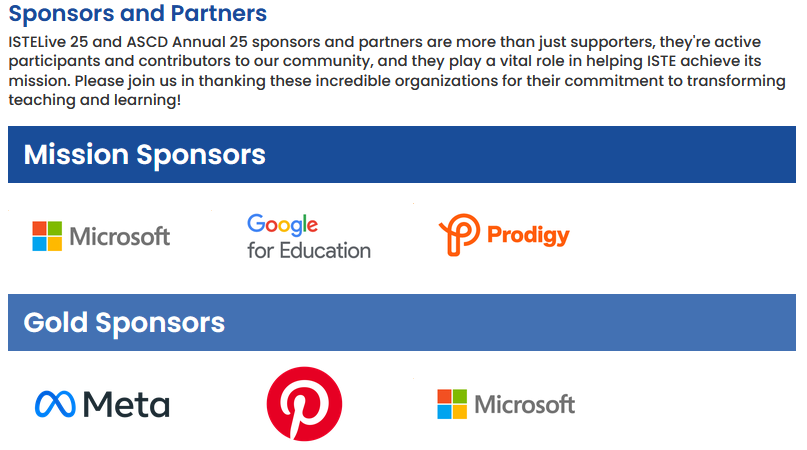
Second, ISTE would like us to believe that the research is clear and that EdTech products “benefit learning when it is well-designed, well-implemented, and aligned to clear learning goals.”4
Even if we could look past their funding (we can’t), we would still have questions about this “research.” Just saying “research shows” tells us nothing about who funded and completed the research, what they studied, if the research is replicable, what the effect size is, or what we should or could interpret from this “research.” (Emily has an entire essay here about vetting EdTech research.)
Un-washing ISTE’s “research”
Because so many school districts cite ISTE’s “research” as evidence of EdTech product effectiveness, let’s look at what ISTE claims are the “four themes [that] consistently emerge across the evidence.”
Screenwash 1: “Quality matters more than quantity.”
Reality: Quality learning requires a teacher and traditional tools.
While “quality matters” might be true when talking about friendships or food, when it comes to EdTech products this is a marketing ploy. “Quality” teaching and learning requires a multisensorial world built on human relationships, something an EdTech product can never offer.
ISTE argues that quality matters more than quantity when it comes to educational technology. We assume they mean that there are better quality EdTech products out there, and those are the ones children should use. However, the scientific study they cite (Støle et al., 2020) to prove their claim that “poorly built EdTech adds unnecessary cognitive load, thus inhibiting learning and academic performance,” is a study that concludes this (bold ours):
“Our finding that students across all skill levels perform more poorly on a digital test than on paper, is an urgent call for a more nuanced perspective on implementation of digital technologies in elementary education, and a signal to policy makers, school administrators and educators that the medium matters, especially for reading comprehension.”
This study doesn’t support the claim that there are differences in quality between high and low quality EdTech products; this study supports the claim that reading on paper is superior to reading digitally.5
As the parent-led child advocacy group Child First Policy Center recently noted at the Power of Parents Summit: “Big Tech has deep pockets, but parents have deep purpose, and Big Tech will never be able to compete with that.”
Screenwash 2: “EdTech is particularly impactful for underserved students.”
Reality: EdTech is particularly harmful for underserved students.
The argument that EdTech will decrease inequities is pervasive and dangerous. Of course, technological equity in education is a complex topic. Historically, underserved students lacked access to computers and technology, and efforts were made to “close the digital divide.” But in 2026, the pendulum has swung too far. Today, underserved students spend disproportionate amounts of time on screens, which increases their exposure to harmful content, data and privacy violations, and interferes with optimal learning experiences.
As a result, new digital divides have emerged, and we will increasingly see underserved students provided with “personalized learning” via artificial intelligence,6 robot teachers, and low-quality products, while better resourced schools and communities will ensure their students have human teachers and high quality learning materials. As academic, teacher, writer, and consultant on educational technology and policy Dr. Velislava Hillman notes, a “troubling divide is emerging: mass, app-based instruction for the many, and human tutoring and intellectual exchange reserved for the elite. What is sold as the ‘democratisation’ of education may be entrenching further inequality.”
Worse, teachers and speech-language pathologists like Denise are seeing increased requirements in IEPs and 504s that provide accommodations for more technology-based “solutions” for students with diagnosed learning disabilities, but the impact of the overreliance on these tools for these students is taking a devastating toll.
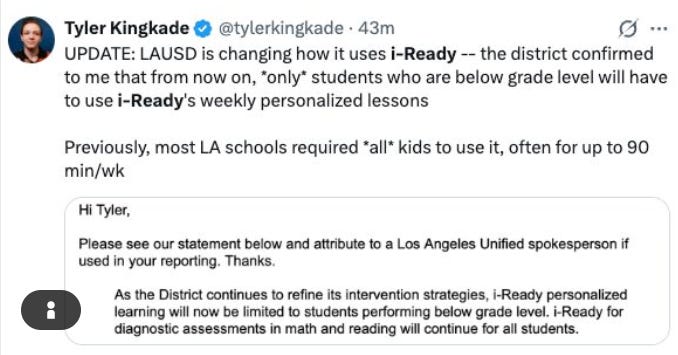
Developing brains need exercise just like any other muscle in the body. But the use of EdTech products claiming to serve as “accessibility tools” in the name of personalized learning actually reduces the opportunity for children to practice and develop their skills on their own. This instead builds dependency on technology-based products and puts an algorithm in charge of evaluating and supporting a child’s learning, rather than a human teacher.7 One of big concerns is that as grassroots efforts continue to grow, districts will acquiesce and reduce EdTech for mainstream students, but double down on students whose learning needs “require” technology, as we are seeing happen in LAUSD:
But this is concerning too, as the research that ISTE cites includes one study with a sample size of only three students diagnosed on the Autism Spectrum. The method of the study investigated those students’ performance using technology on a pre-test/post-test for a science vocabulary lesson on amoebas. The other research cited includes a meta analysis of 72 research studies, but only eighteen of the 72 studies used in the analysis are from the United States and of those, fourteen were completed over a decade ago and five occurred prior to 2010. That isn’t reliable, recent, or representative research.
We’re not the only ones noticing that orgs like ISTE are cherry-picking research and hoping that no one will really look at it. As Dr. Horvath points out in his article, The Equity Illusion of EdTech, “lower-performing students’ [scores] declined far more sharply than their high-performing peers” since the “digital inflection point” of EdTech in schools, around 2012. Other researchers have presented similar findings, noting that since the mid-2010s, the “gap between higher- and lower-performing students has consistently widened across subjects, grade levels, and demographic groups, in all of the best surveys of educational performance in the United States.”
If EdTech products are positively impactful for underserved students, as ISTE claims, wouldn’t we see these students performing better? Wouldn’t those gaps be closing, not widening, with increased access to EdTech products since 2012?
Screenwash 3: ISTE states, “Consumer technology and EdTech are not the same.”
Reality: EdTech is Big Tech, but EdTech isn’t Tech Ed.
True to the wording of Step 2 of the screenwashing playbook (“Insist that we’re confusing or conflating consumer tech with “evidence-based, purpose-built” EdTech”), we see continued effort to present a false binary when it comes to technology– good vs bad, educational vs. entertainment, “consumer tech” vs “EdTech.” As we discussed in our last essay, Instructure8 created a report to help us understand ISTE’s attempt to differentiate “consumer tech” and “EdTech.”
A glimpse at the Big Tech companies who partner with Instructure should be enough to immediately prevent us from seeing their report as independent or useful in advising schools or policymakers about EdTech issues:
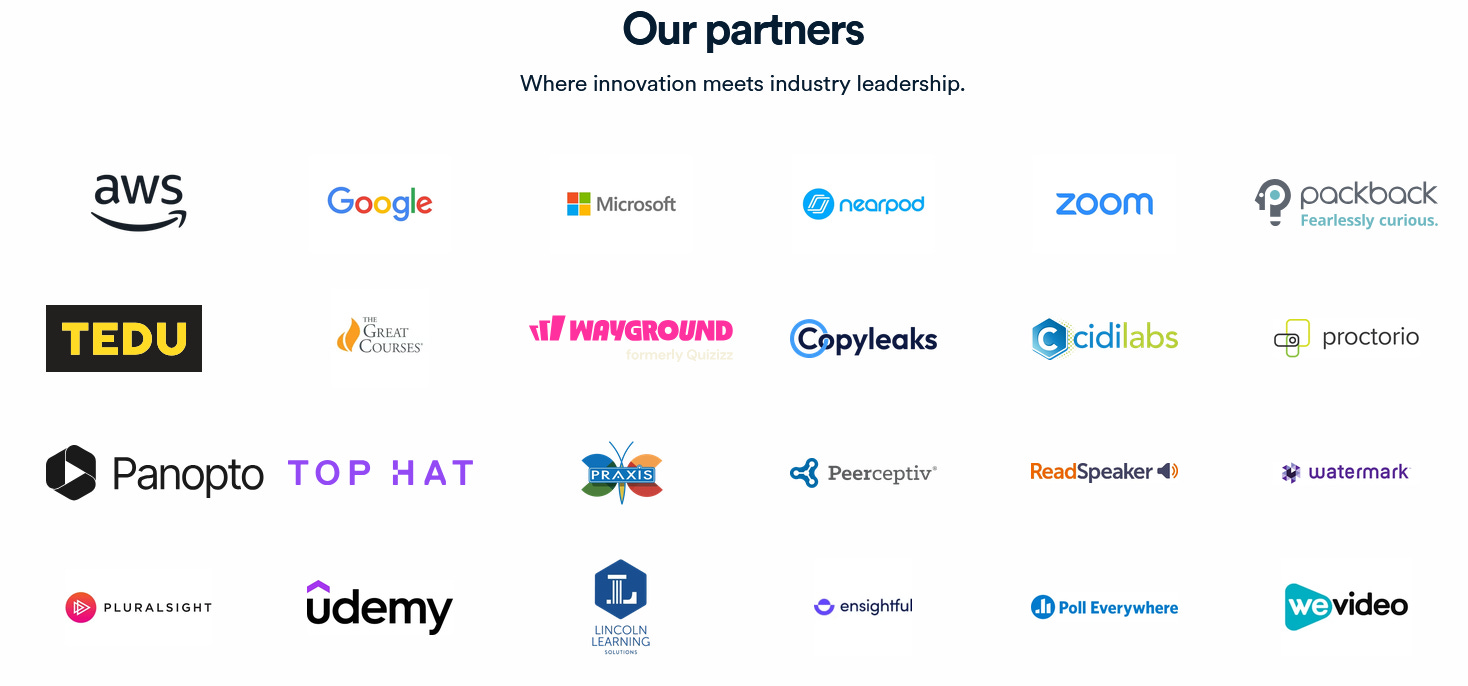
Again, if we were to ignore the extremely problematic funding ties (and we can’t and we won’t), looking deeper into Instructure’s report we see another screenwashing attempt to confuse the consumer and differentiate their products as “Good Tech.” In spite of this attempted reframe, however, the report shows that only 40% of what they deem as the “top EdTech tools” they analyzed have any level of ESSA evidence and and even worse, the majority have only Tier 3 which describes research that shows “promising evidence” and Tier 4 isn’t even research - it’s a rationale!
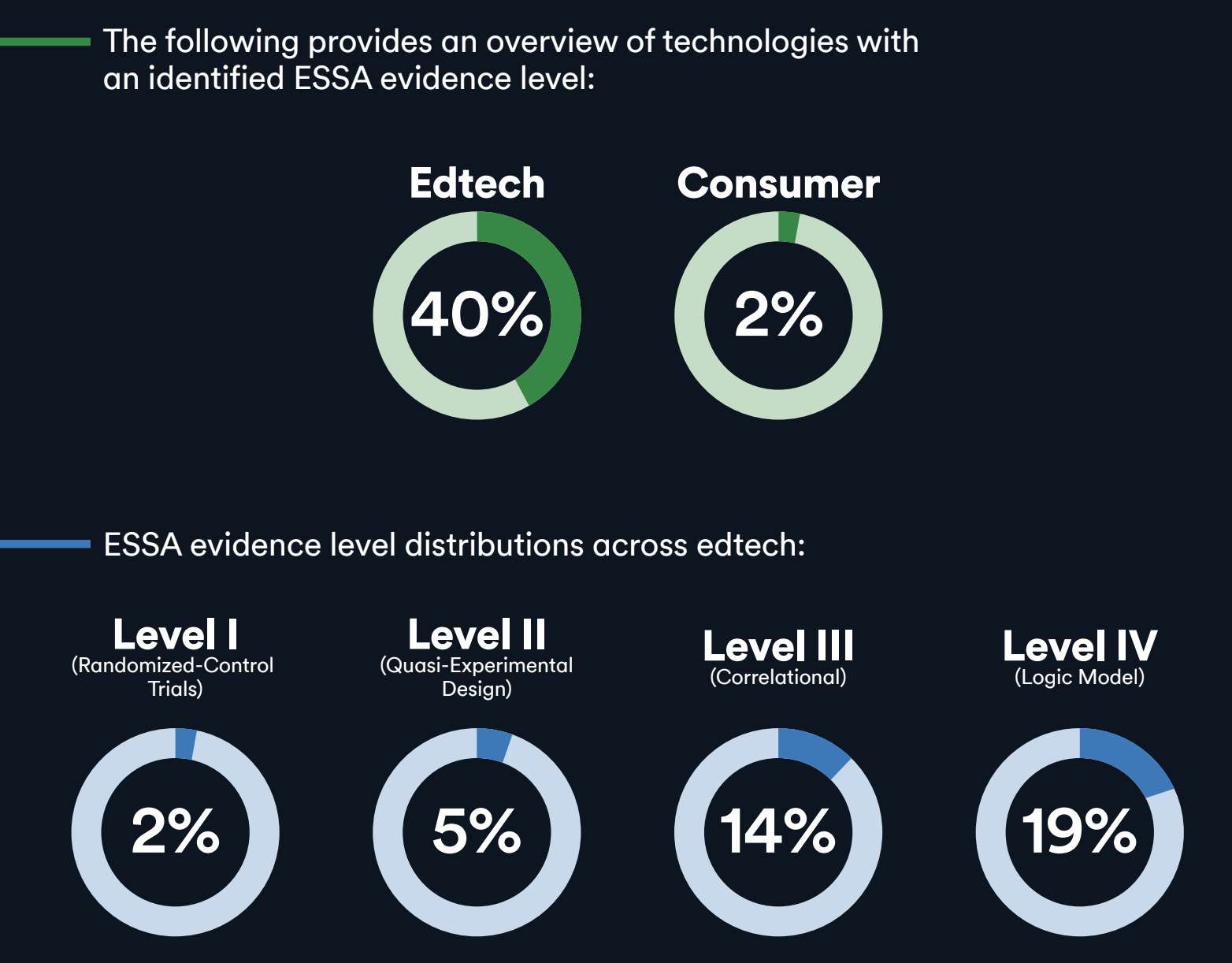
Every Student Succeeds Act, or ESSA, is a national education law which replaced No Child Left Behind in 2015. Their “tiers” of “evidence” are (theoretically) used to “provide districts and schools with a framework for determining which programs, practices, strategies, and interventions work in which contexts and for which students.” If we assume that ESSA’s framework is rooted in guidance that focuses on what is best for children and learning, then how is it that only 2% of EdTech products show strong evidence of effectiveness? Only 2%!
It’s not like this 2% finding is coming from an organization critical of EdTech; it’s coming from a report on EdTech products written by an organization who is funded by the tech industry itself. Can you imagine if this level of ineffectiveness applied to other consumer products? Sorry, your Clorox bleach cleaner only kills 2% of bacteria, not 99%. Or, your child’s car seat meets the federal safety standard only 2% of the time? It is shocking to see these numbers and know that most school districts are still choosing to deploy hundreds of EdTech products anyway.
As if those numbers weren’t bad enough, the report also attempts another reframe by posing the question: “What can consumer technologies do to be more effective in schools?” We would find this question far more useful to answer first: “Why are consumer tech products in schools in the first place?” We know why, of course (the business model again), but if the EdTech industry can repackage the same product with a new purpose, perhaps school leaders won’t ask the second question, and life can continue as normal.
Screenwash 4: ISTE says “Teachers are doing it all wrong–they just need to learn from us how to use the products the right way!”
Reality: This is pinning the problem on teachers, when in reality it’s a product problem.
Ok, that isn’t exactly what ISTE states in their fourth theme, but it is what they imply. As we would expect from an industry who continues to shirk responsibility, teachers are a convenient scapegoat. If we blame the teacher for failing to implement a product “with fidelity” then we do not have to admit the product is terrible. Thus, their logic follows, teachers actually need more training and professional development on how to teach while using these products, which, what a surprise, conveniently requires districts to pony up even more money to these companies.
Obviously, blaming teachers is the opposite of what is true and what we believe. Of course, technology companies like OpenAI and Microsoft have complicated the solution by partnering with one of the largest teachers unions, offering the AFT millions of dollars in funding to create a National Academy of AI Instruction that will provide AI training to teachers. This “groundbreaking $23 million education initiative” will provide access to “free AI training and curriculum for all 1.8 million members of the AFT, starting with K-12 educators.” A familiar pattern here– criticize the user for failing to implement the product effectively, partner with their largest union to provide the “right” training, and come out looking like the (increasingly wealthy) problem-solver.
Don’t forget– in January of 2026, the AFT and NEA, two of the largest American teachers’ unions, signed on to a letter written by yet another tech-friendly “organization” in an attempt to preemptively counter the testimony that Emily and Dr. Horvath provided for Congress. The letter stated that the signatories saw a difference between “unsupervised, entertainment-driven technology use at home” and the “intentional, monitored, and carefully curated use of technology in schools.” In many ways, this letter marked the start of the industry-backed groups rebranding efforts. We saw through it then, and we will continue to call it out now.

So what can we do?
We propose four useful actions to counter EdTech screenwashing.
Get informed. Learn to identify the four steps of the Screenwashing Playbook and call them out each time you hear one from your district leadership, skeptical parents, an EdTech executive, or even members of the media. Here are a few resources we recommend:
From Bans to Recalls: A Public Health Framework for AI Companion Bots (Gaia Bernstein of the Brookings Institute
A Product Safety Playbook for the Digital Age (Lisa Levasseur of Internet Safety Labs)
Get active. This fall will be unprecedented in EdTech resistance. Ride the wave. Email your school board directors, testify at school board meetings, challenge the pro-EdTech messaging you hear at Back-to-School Night, contact your local representatives. Express your concerns and ask them for the evidence they use to justify the costs and risks. Then look at that research and challenge it if it is industry-funded. Respectfully, of course, but with conviction. Here are a few resources we recommend:
Emily has a lot of sample public testimony on her Substack.
The Distraction-Free Policy Project hosts weekly action-oriented calls
Join Fairplay’s Screens-in-Schools Action Network (Emily is co-chair!)
Get together. There has never been more pushback on EdTech than there is right now. The wind is at our back. Don’t accept “You can’t opt out” or “This platform isn’t optional” as an ending; see it as the opening salvo for further conversation. Other parents are asking these same questions. Find each other. Work together. Here are a few resources we recommend:
Download Emily’s free Unplug EdTech Toolkit
Our friends at Schools Beyond Screens can help you open a local chapter
Check out the model legislation at The Distraction-Free Policy Project
Get optimistic. Don’t give in. Don’t settle for “this is just the way things are now.” Don’t accept that GenAI and EdTech products are a foregone conclusion. They are not. These companies are worried, as evidenced by the hate mail and death threats we’ve both gotten for speaking up and out about this. But it’s because they know we are right, and they see the pushback growing from all over the world. We have to keep swimming.
Photo by Rachel Hisko on Unsplash

There is also a new lawsuit against Curriculum Associates, parent company of iReady, alleging false advertising. Curriculum Associates is having a rough summer, but these cases are just the tip of the iceberg. More will follow.
ISTE is formerly known as the “International Society for Technology in Education.” They merged with Association for Supervision and Curriculum Development (ASCD) in 2022 and recently rebranded themselves as the International Society for Transforming Education.
For those who want to learn more about “the quality of the product” mattering “dramatically,” check out the book, The Digital Delusion, by our friend and colleague, Dr. Jared Cooney Horvath, which provides a detailed breakdown of the research and clearly articulates how technology impedes the learning process.
It is called "artificial" intelligence. We want our kids to have something "artificial”— and in schools, no less?
EdTech product use is especially harmful– not helpful– to our most vulnerable students. Denise has written about how the overuse of technology can impede struggling learners, including in her easy, We Can't Ignore This for Another Decade. Denise also wrote about how the EdTech industry intentionally attempts to confuse well-meaning educators and instill fear in parents with claims that removing technology will harm their learning here: Be Leary of EdTech Industry Narratives.
Parent company of the EdTech product Canvas and actively being sued.
 | A guest post by
|
Thank you Emily. When will teachers demand that their unions not sell them out? When teacher unions take money from EdTech companies, this benefits union leadership but hurts teachers by reducing demand for their services which will in turn hurt their incomes and raise class size.